graph the equation.\ny = -2|x|
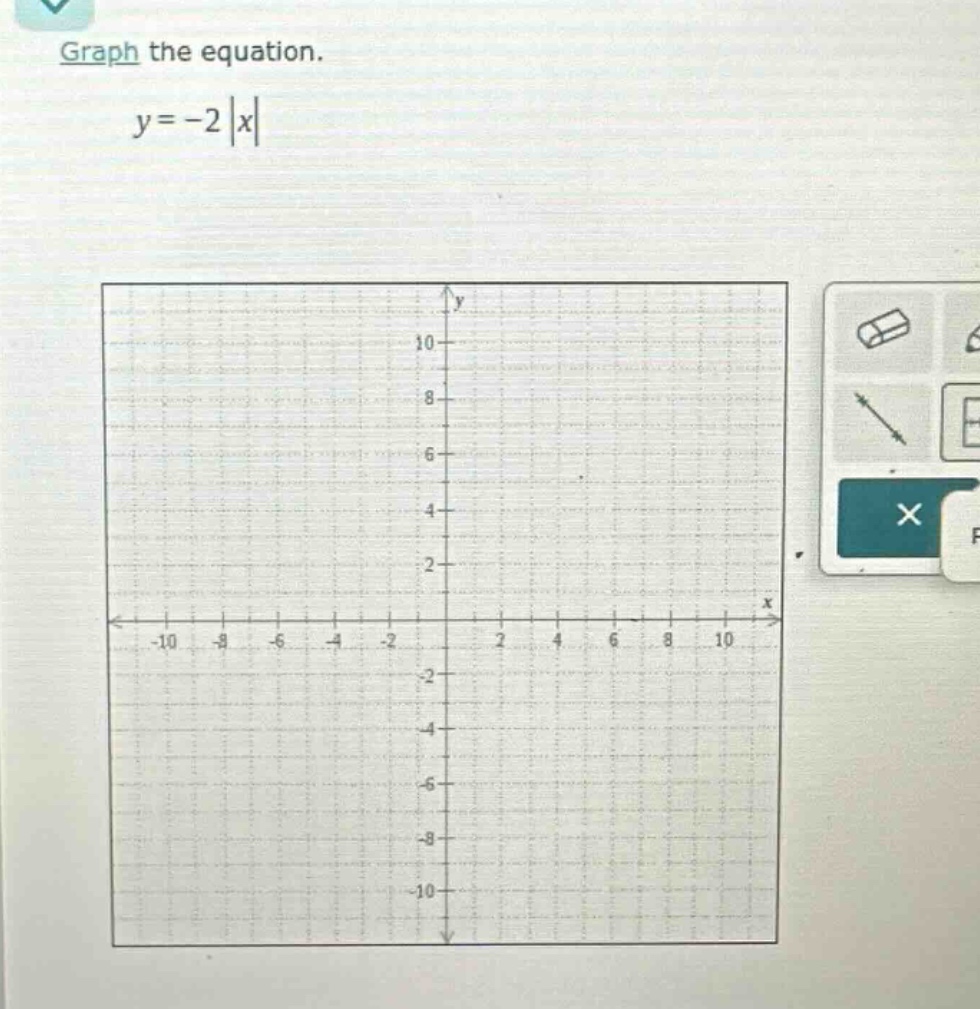
graph the equation.\ny = -2|x|
Answer
Explanation:
Step 1: Identify the base function and transformations
The base function is ( y = |x| ), which is a V-shaped graph with vertex at (0,0). The equation ( y = -2|x| ) involves a vertical stretch by a factor of 2 and a reflection over the x-axis.
Step 2: Determine key points for ( x \geq 0 )
For non-negative x, the equation simplifies to ( y = -2x ). Choose x-values:
- When ( x = 0 ), ( y = 0 )
- When ( x = 1 ), ( y = -2 )
- When ( x = 2 ), ( y = -4 )
Step 3: Use symmetry for ( x < 0 )
Since ( |x| = |-x| ), the graph is symmetric about the y-axis. For negative x-values:
- When ( x = -1 ), ( y = -2 )
- When ( x = -2 ), ( y = -4 )
Step 4: Plot points and draw the graph
Plot the vertex (0,0) and the symmetric points. Connect them with straight lines forming a downward-opening V-shape. The slope for ( x > 0 ) is -2, and for ( x < 0 ) is 2 (due to the absolute value symmetry).
Answer:
The graph is a downward-opening V-shape with vertex at the origin (0,0), passing through points such as (1, -2), (-1, -2), (2, -4), (-2, -4), etc. The arms have slopes of -2 (for ( x > 0 )) and 2 (for ( x < 0 )).