graph each equation.\n9) \\(\\dfrac{x^2}{4} + \\dfrac{y^2}{9} = 1\\)
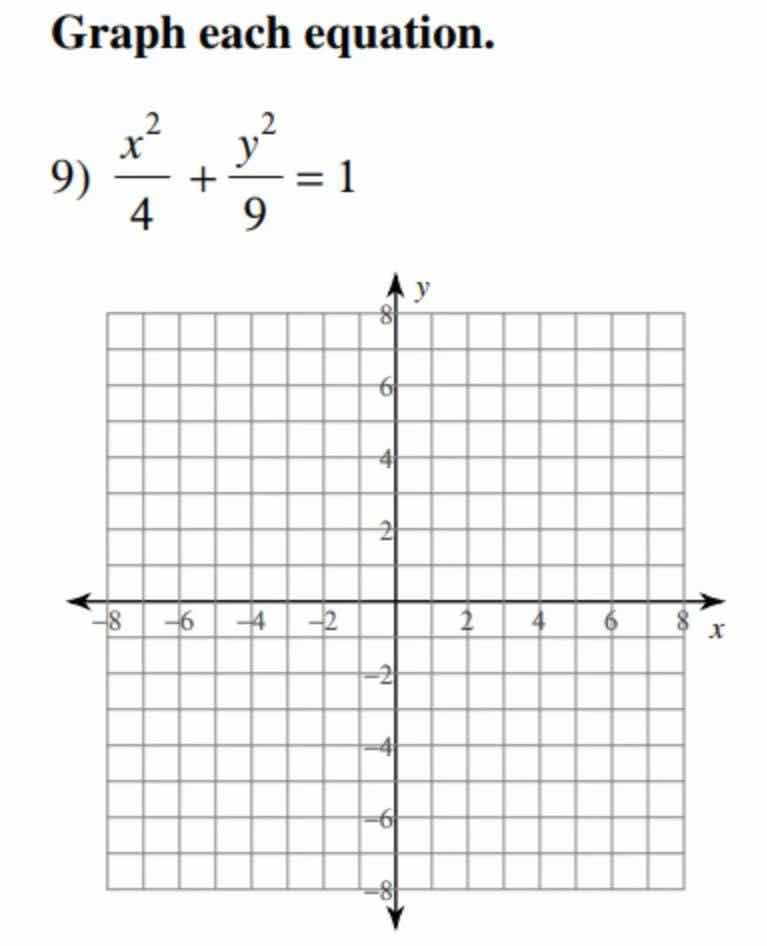
graph each equation.\n9) \\(\\dfrac{x^2}{4} + \\dfrac{y^2}{9} = 1\\)
Answer
Explanation:
Step1: Identify the conic section
The equation (\frac{x^{2}}{4}+\frac{y^{2}}{9} = 1) is in the standard form of an ellipse (\frac{x^{2}}{b^{2}}+\frac{y^{2}}{a^{2}}=1) (where (a>b>0)), which is a vertical ellipse centered at the origin ((0,0)).
Step2: Find the vertices and co - vertices
For the ellipse (\frac{x^{2}}{b^{2}}+\frac{y^{2}}{a^{2}} = 1), we have (a^{2}=9) so (a = 3) and (b^{2}=4) so (b = 2).
- The vertices (end - points of the major axis) are at ((0,\pm a)=(0,\pm3)).
- The co - vertices (end - points of the minor axis) are at ((\pm b,0)=(\pm2,0)).
Step3: Plot the points
- Plot the vertices ((0,3)) and ((0, - 3)) on the (y) - axis.
- Plot the co - vertices ((2,0)) and ((- 2,0)) on the (x) - axis.
Step4: Draw the ellipse
Connect the plotted points ((0,3)), ((2,0)), ((0, - 3)), and ((- 2,0)) with a smooth curve to form the ellipse. The ellipse will be symmetric about both the (x) - axis and (y) - axis.
Answer:
The graph is an ellipse centered at the origin with vertices at ((0,3)), ((0, - 3)) and co - vertices at ((2,0)), ((- 2,0)) (the actual drawing is a smooth curve passing through these points and symmetric about both axes).