graph each equation.\n9) \\(dfrac{x^2}{4} + dfrac{y^2}{9} = 1\\)
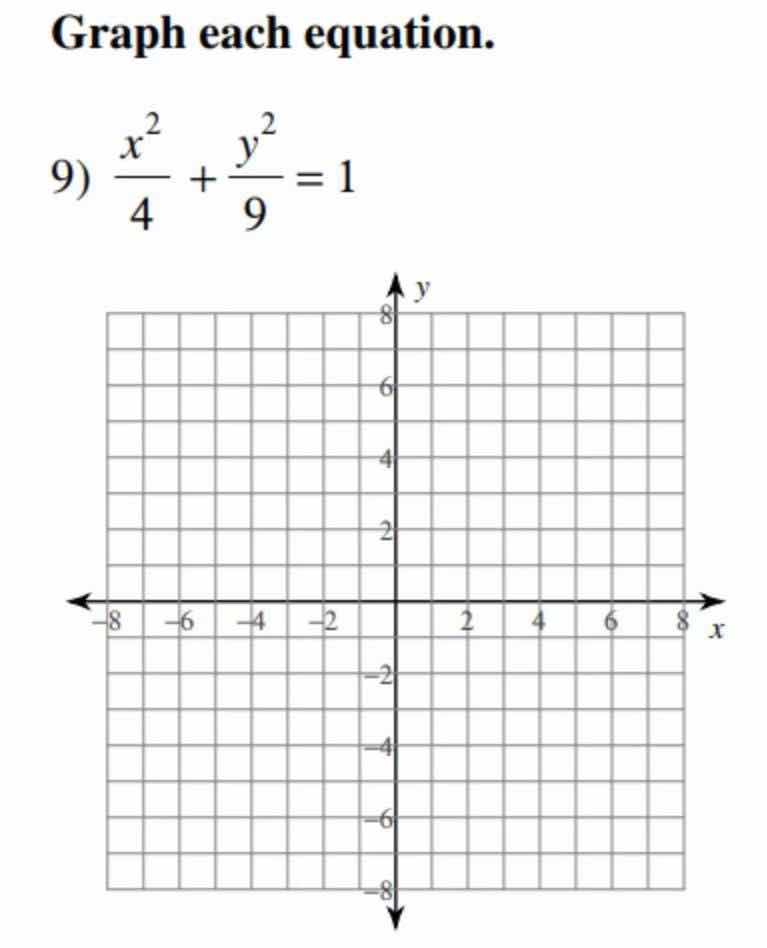
graph each equation.\n9) \\(dfrac{x^2}{4} + dfrac{y^2}{9} = 1\\)
Answer
Explanation:
Step1: Identify the conic section
The equation is (\frac{x^2}{4}+\frac{y^2}{9} = 1), which is in the standard form of an ellipse (\frac{x^2}{b^2}+\frac{y^2}{a^2}=1) (since (a^2 = 9) and (b^2=4), so (a = 3), (b = 2)) with a vertical major axis (because (a>b) and the (y^2) term has the larger denominator).
Step2: Find the vertices and co - vertices
- For the (y) - axis (major axis) vertices: When (x = 0), we solve for (y). Substitute (x = 0) into the equation (\frac{0^2}{4}+\frac{y^2}{9}=1), which gives (y^2=9), so (y=\pm3). So the vertices are ((0, 3)) and ((0,- 3)).
- For the (x) - axis (minor axis) co - vertices: When (y = 0), we solve for (x). Substitute (y = 0) into the equation (\frac{x^2}{4}+\frac{0^2}{9}=1), which gives (x^2 = 4), so (x=\pm2). So the co - vertices are ((2,0)) and ((- 2,0)).
Step3: Plot the points and draw the ellipse
Plot the points ((0,3)), ((0, - 3)), ((2,0)) and ((-2,0)) on the coordinate plane. Then, sketch the ellipse by connecting these points smoothly, making sure that the ellipse is symmetric about both the (x) - axis and (y) - axis.
To graph the ellipse:
- Mark the center at the origin ((0,0)) (since there are no shifts in the (x) or (y) terms in the equation (\frac{x^2}{4}+\frac{y^2}{9}=1)).
- Plot the vertices ((0,3)) (3 units up from the center on the (y) - axis) and ((0, - 3)) (3 units down from the center on the (y) - axis).
- Plot the co - vertices ((2,0)) (2 units to the right of the center on the (x) - axis) and ((-2,0)) (2 units to the left of the center on the (x) - axis).
- Draw a smooth curve connecting these four points, forming an ellipse that is wider along the (y) - axis.
Answer:
The graph is an ellipse centered at the origin with vertices at ((0, \pm 3)) and co - vertices at ((\pm 2,0)), plotted as described above.