graph each equation.\n9) \\(\\frac{x^2}{4} + \\frac{y^2}{9} = 1\\)\ngraph with x-axis from -8 to 8 and…
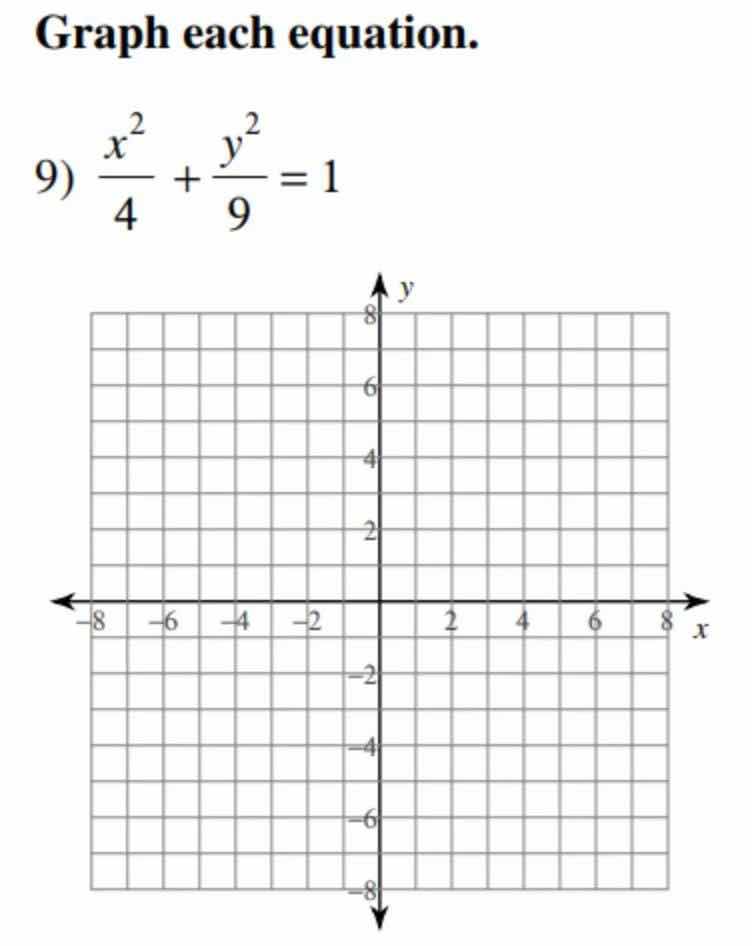
graph each equation.\n9) \\(\\frac{x^2}{4} + \\frac{y^2}{9} = 1\\)\ngraph with x-axis from -8 to 8 and y-axis from -8 to 8, grid lines, origin at (0,0)
Answer
Explanation:
Step1: Identify the conic section
The equation (\frac{x^{2}}{4}+\frac{y^{2}}{9} = 1) is in the standard form of an ellipse (\frac{x^{2}}{b^{2}}+\frac{y^{2}}{a^{2}}=1) (where (a>b>0)), which is a vertical ellipse centered at the origin ((0,0)).
Step2: Find the vertices and co - vertices
For the ellipse (\frac{x^{2}}{b^{2}}+\frac{y^{2}}{a^{2}}=1), we have (a^{2}=9) so (a = 3) and (b^{2}=4) so (b = 2).
- The vertices (end - points of the major axis) are at ((0,\pm a)=(0,\pm3)).
- The co - vertices (end - points of the minor axis) are at ((\pm b,0)=(\pm2,0)).
Step3: Plot the points
- Plot the center ((0,0)).
- Plot the vertices ((0,3)) and ((0, - 3)).
- Plot the co - vertices ((2,0)) and ((-2,0)).
Step4: Sketch the ellipse
Connect the plotted points smoothly to form the ellipse. The ellipse will be symmetric about both the (x) - axis and (y) - axis. It will be taller along the (y) - axis (since (a = 3) and (b = 2)) with the top vertex at ((0,3)), bottom vertex at ((0,-3)), right co - vertex at ((2,0)) and left co - vertex at ((-2,0)).
Answer:
The graph is an ellipse centered at the origin with vertices at ((0,\pm3)) and co - vertices at ((\pm2,0)) (the ellipse is drawn by connecting these points smoothly, symmetric about the (x) - axis and (y) - axis).