the graph of an equation with a negative discriminant always has which characteristic?\nno x - intercept\nno…
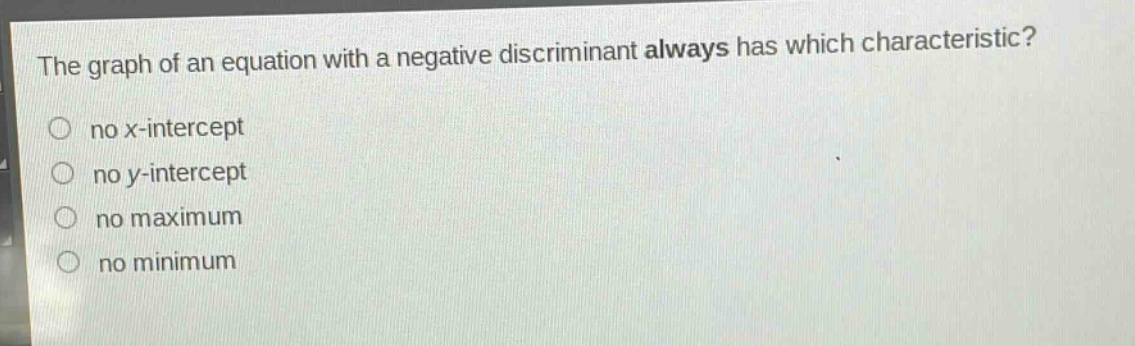
the graph of an equation with a negative discriminant always has which characteristic?\nno x - intercept\nno y - intercept\nno maximum\nno minimum
Answer
Brief Explanations:
For a quadratic equation $ax^{2}+bx + c=0$, the discriminant is $\Delta=b^{2}-4ac$. The $x$-intercepts are the solutions of the equation. When $\Delta<0$, the quadratic formula $x=\frac{-b\pm\sqrt{b^{2}-4ac}}{2a}$ gives non - real solutions. So, the graph of the quadratic function $y = ax^{2}+bx + c$ does not cross the $x$-axis. A quadratic function always has a $y$-intercept (when $x = 0$, $y=c$), and it has either a maximum or a minimum depending on the sign of $a$.
Answer:
no x-intercept