how does the graph of $g(x)=\frac{1}{x + 4}-6$ compare to the graph of the parent function…
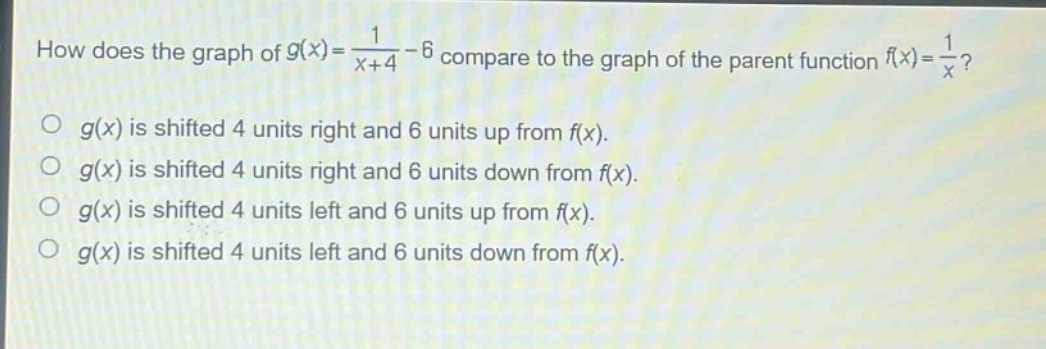
how does the graph of $g(x)=\frac{1}{x + 4}-6$ compare to the graph of the parent function $f(x)=\frac{1}{x}$?\n$g(x)$ is shifted 4 units right and 6 units up from $f(x)$.\n$g(x)$ is shifted 4 units right and 6 units down from $f(x)$.\n$g(x)$ is shifted 4 units left and 6 units up from $f(x)$.\n$g(x)$ is shifted 4 units left and 6 units down from $f(x)$.
Answer
Explanation:
Step1: Analyze horizontal shift
For a function of the form $y = \frac{1}{x - h}+k$ compared to $y=\frac{1}{x}$, the horizontal shift is determined by the value of $h$. In $g(x)=\frac{1}{x + 4}-6=\frac{1}{x-(- 4)}-6$, when comparing to $f(x)=\frac{1}{x}$, the value of $h=-4$. A negative $h$ value means a left - shift. So, there is a 4 - unit left shift.
Step2: Analyze vertical shift
The vertical shift is determined by the value of $k$. In $g(x)=\frac{1}{x + 4}-6$, the value of $k=-6$. A negative $k$ value means a downward shift. So, there is a 6 - unit down shift.
Answer:
$g(x)$ is shifted 4 units left and 6 units down from $f(x)$.