the graph of which function has an axis of symmetry at x = 3?\n○ f(x)=x² + 3x + 1\n○ f(x)=x² - 3x - 3
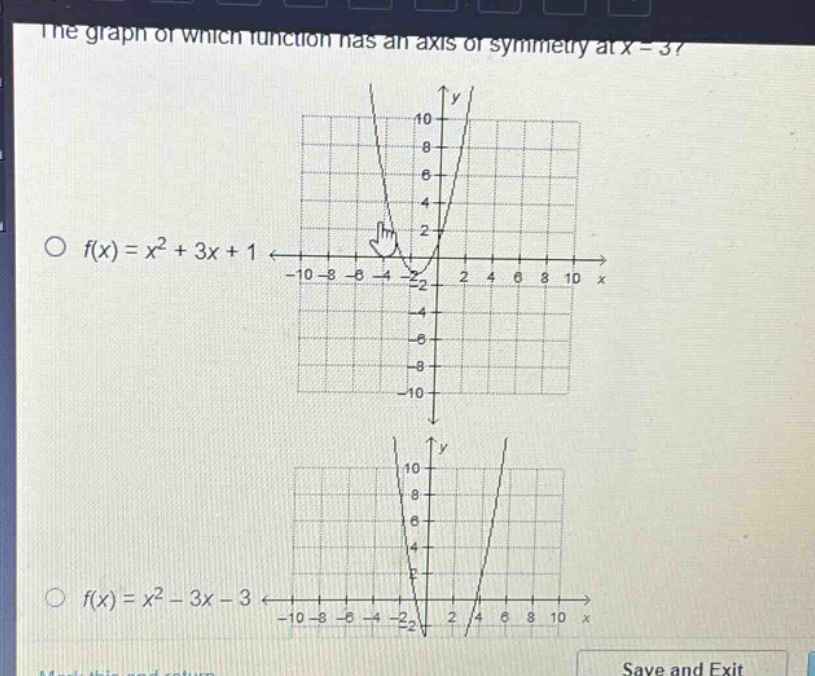
the graph of which function has an axis of symmetry at x = 3?\n○ f(x)=x² + 3x + 1\n○ f(x)=x² - 3x - 3
Answer
Explanation:
Step1: Recall axis - of - symmetry formula
For a quadratic function $f(x)=ax^{2}+bx + c$, the axis of symmetry is given by the formula $x =-\frac{b}{2a}$.
Step2: Check the first function
For $f(x)=x^{2}+3x + 1$, where $a = 1$ and $b = 3$. Then $x=-\frac{3}{2\times1}=-\frac{3}{2}$.
Step3: Check the second function
For $f(x)=x^{2}-3x - 3$, where $a = 1$ and $b=-3$. Then $x=-\frac{-3}{2\times1}=\frac{3}{2}$. Since neither of the given functions has an axis of symmetry at $x = 3$, there seems to be an error in the problem setup as no correct option is provided among the given ones. But if we were to follow the process for a general quadratic to find the axis of symmetry, we use the $x=-\frac{b}{2a}$ formula.
If we assume there are more options not shown, the correct function would be one where for $f(x)=ax^{2}+bx + c$, when $a\neq0$ and $-\frac{b}{2a}=3$, or $b=-6a$. For example, $f(x)=x^{2}-6x + 1$ (where $a = 1$ and $b=-6$) has an axis of symmetry $x=-\frac{-6}{2\times1}=3$.
Since the problem seems incomplete in terms of options, we can't give a definite answer from the provided choices. But the method to find the axis of symmetry of a quadratic function is as shown above.