the graph of which function is decreasing over the interval (-4, ∞)?\n○ f(x)=(x + 4)^2+4\n○ f(x)=-(x +…
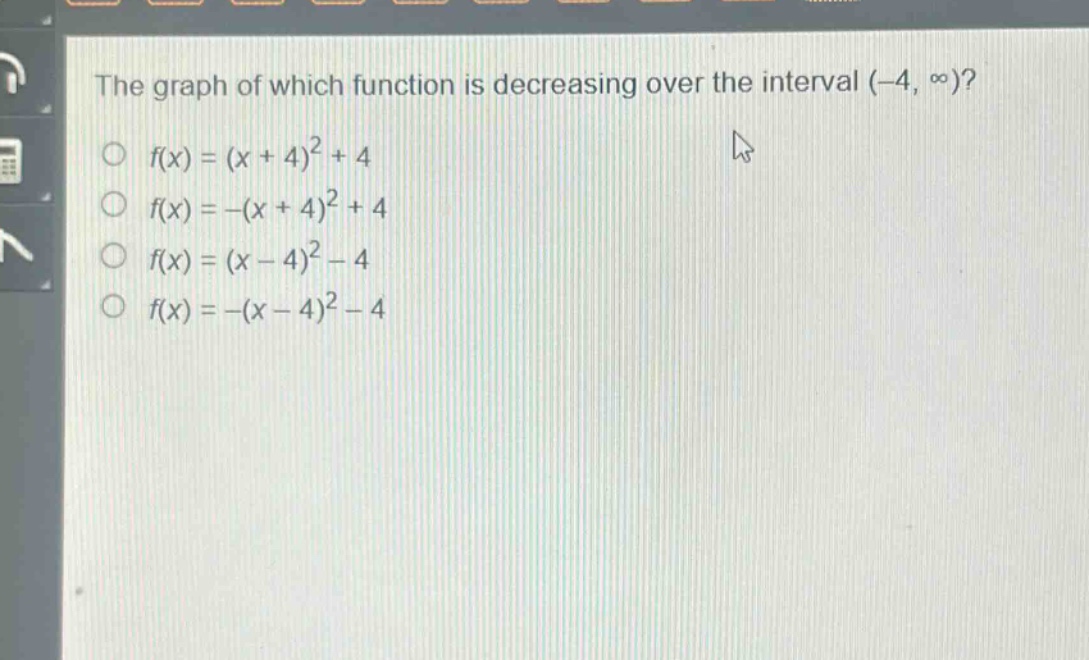
the graph of which function is decreasing over the interval (-4, ∞)?\n○ f(x)=(x + 4)^2+4\n○ f(x)=-(x + 4)^2+4\n○ f(x)=(x - 4)^2-4\n○ f(x)=-(x - 4)^2-4
Answer
Explanation:
Step1: Recall vertex - form of a quadratic function
The vertex - form of a quadratic function is $y=a(x - h)^2+k$, where $(h,k)$ is the vertex of the parabola. If $a>0$, the parabola opens upward, and if $a < 0$, the parabola opens downward.
Step2: Analyze the first function $f(x)=(x + 4)^2+4$
Here, $a = 1>0$, $h=-4$, $k = 4$. The parabola opens upward. The function is decreasing on the interval $(-\infty,-4)$ and increasing on the interval $(-4,\infty)$.
Step3: Analyze the second function $f(x)=-(x + 4)^2+4$
Here, $a=-1<0$, $h = - 4$, $k = 4$. The parabola opens downward. The function is increasing on the interval $(-\infty,-4)$ and decreasing on the interval $(-4,\infty)$.
Step4: Analyze the third function $f(x)=(x - 4)^2-4$
Here, $a = 1>0$, $h = 4$, $k=-4$. The parabola opens upward. The function is decreasing on the interval $(-\infty,4)$ and increasing on the interval $(4,\infty)$.
Step5: Analyze the fourth function $f(x)=-(x - 4)^2-4$
Here, $a=-1<0$, $h = 4$, $k=-4$. The parabola opens downward. The function is increasing on the interval $(-\infty,4)$ and decreasing on the interval $(4,\infty)$.
Answer:
$f(x)=-(x + 4)^2+4$