the graph of which function is decreasing over the interval (-4, ∞)?\no f(x)=(x + 4)^2+4\no f(x)=-(x +…
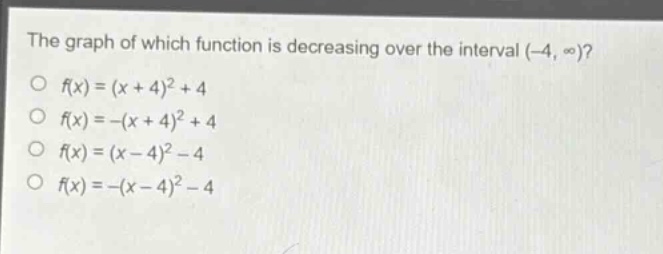
the graph of which function is decreasing over the interval (-4, ∞)?\no f(x)=(x + 4)^2+4\no f(x)=-(x + 4)^2+4\no f(x)=(x - 4)^2-4\no f(x)=-(x - 4)^2-4
Answer
Explanation:
Step1: Recall vertex - form of quadratic function
The vertex - form of a quadratic function is (y = a(x - h)^2+k), where ((h,k)) is the vertex of the parabola. If (a>0), the parabola opens upward, and if (a < 0), the parabola opens downward. The function is increasing on one side of the vertex and decreasing on the other side.
Step2: Analyze each option
Option 1: (f(x)=(x + 4)^2+4)
Here (a = 1>0), (h=-4), (k = 4). The parabola opens upward. The function is decreasing on the interval ((-\infty,-4)) and increasing on the interval ((-4,\infty)).
Option 2: (f(x)=-(x + 4)^2+4)
Here (a=-1<0), (h = - 4), (k = 4). The parabola opens downward. The function is increasing on the interval ((-\infty,-4)) and decreasing on the interval ((-4,\infty)).
Option 3: (f(x)=(x - 4)^2-4)
Here (a = 1>0), (h = 4), (k=-4). The parabola opens upward. The function is decreasing on the interval ((-\infty,4)) and increasing on the interval ((4,\infty)).
Option 4: (f(x)=-(x - 4)^2-4)
Here (a=-1<0), (h = 4), (k=-4). The parabola opens downward. The function is increasing on the interval ((-\infty,4)) and decreasing on the interval ((4,\infty)).
Answer:
(f(x)=-(x + 4)^2+4)