the graph of which function has a minimum located at (4, -3)?\n$f(x)=-\frac{1}{2}x^{2}+4x…
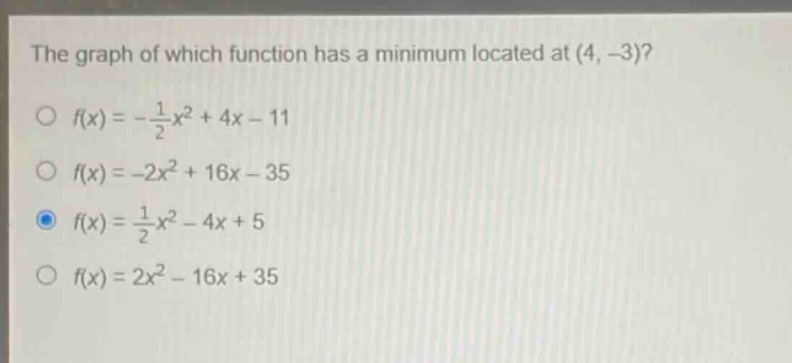
the graph of which function has a minimum located at (4, -3)?\n$f(x)=-\frac{1}{2}x^{2}+4x - 11$\n$f(x)=-2x^{2}+16x - 35$\n$f(x)=\frac{1}{2}x^{2}-4x + 5$\n$f(x)=2x^{2}-16x + 35$
Answer
Explanation:
Step1: Recall vertex - form of a quadratic function
The vertex - form of a quadratic function is $f(x)=a(x - h)^2+k$, where the vertex (minimum or maximum) is at the point $(h,k)$. For a quadratic function $y = ax^{2}+bx + c$, the x - coordinate of the vertex is given by $x=-\frac{b}{2a}$.
Step2: For option $f(x)=-\frac{1}{2}x^{2}+4x - 11$
Here $a =-\frac{1}{2}$ and $b = 4$. Then $x=-\frac{4}{2\times(-\frac{1}{2})}=-\frac{4}{-1}=4$. Substitute $x = 4$ into $f(x)$: $f(4)=-\frac{1}{2}(4)^{2}+4\times4 - 11=-\frac{1}{2}\times16 + 16-11=-8 + 16-11=-3$. But since $a=-\frac{1}{2}<0$, the parabola opens downwards and $(4, - 3)$ is a maximum.
Step3: For option $f(x)=-2x^{2}+16x - 35$
Here $a=-2$ and $b = 16$. Then $x=-\frac{16}{2\times(-2)}=4$. Substitute $x = 4$ into $f(x)$: $f(4)=-2(4)^{2}+16\times4 - 35=-2\times16+64 - 35=-32 + 64-35=-3$. But since $a=-2<0$, the parabola opens downwards and $(4,-3)$ is a maximum.
Step4: For option $f(x)=\frac{1}{2}x^{2}-4x + 5$
Here $a=\frac{1}{2}$ and $b=-4$. Then $x=-\frac{-4}{2\times\frac{1}{2}} = 4$. Substitute $x = 4$ into $f(x)$: $f(4)=\frac{1}{2}(4)^{2}-4\times4 + 5=\frac{1}{2}\times16-16 + 5=8-16 + 5=-3$. Since $a=\frac{1}{2}>0$, the parabola opens upwards and $(4,-3)$ is a minimum.
Step5: For option $f(x)=2x^{2}-16x + 35$
Here $a = 2$ and $b=-16$. Then $x=-\frac{-16}{2\times2}=4$. Substitute $x = 4$ into $f(x)$: $f(4)=2(4)^{2}-16\times4 + 35=2\times16-64 + 35=32-64 + 35=3$.
Answer:
$f(x)=\frac{1}{2}x^{2}-4x + 5$