the graph of the function f(x)=(x + 2)(x + 6) is shown below. which statement about the function is true…
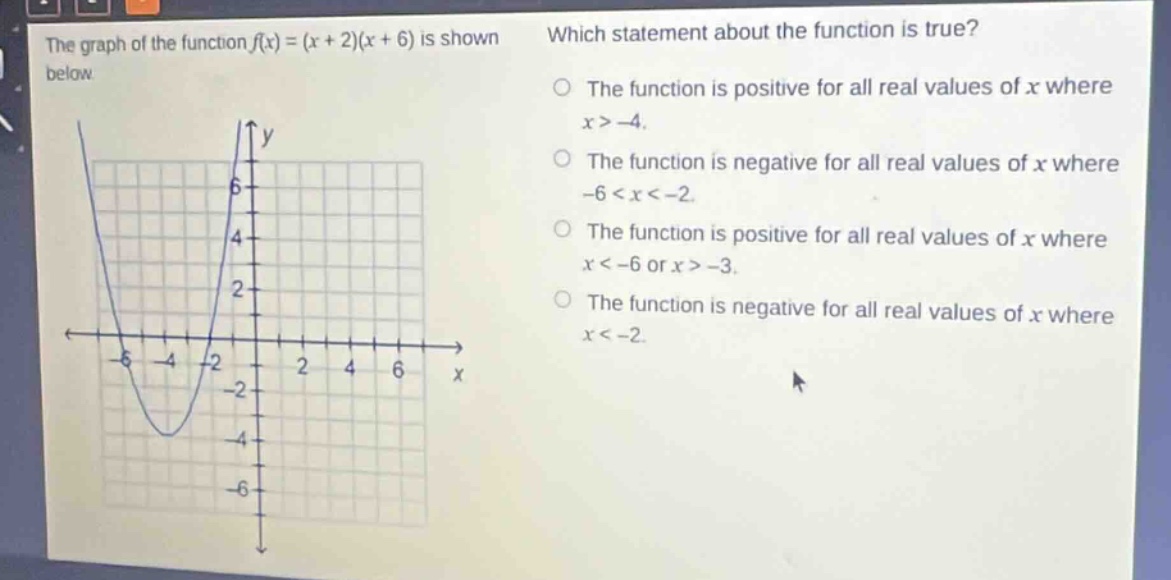
the graph of the function f(x)=(x + 2)(x + 6) is shown below. which statement about the function is true? the function is positive for all real values of x where x > -4. the function is negative for all real values of x where -6 < x < -2. the function is positive for all real values of x where x < -6 or x > -3. the function is negative for all real values of x where x < -2.
Answer
Explanation:
Step1: Find the roots of the function
Set (f(x)=(x + 2)(x + 6)=0). Using the zero - product property, (x+2 = 0) gives (x=-2) and (x + 6=0) gives (x=-6). These are the (x) - intercepts of the parabola (y=(x + 2)(x + 6)=x^{2}+8x + 12), which opens upward (since the coefficient of (x^{2}) is positive, (a = 1>0) in (y=ax^{2}+bx + c)).
Step2: Analyze the sign of the function in intervals
The intervals are ((-\infty,-6)), ((-6,-2)) and ((-2,\infty)). For (x<-6), let (x=-7), then (f(-7)=(-7 + 2)(-7 + 6)=(-5)\times(-1)=5>0). For (-6<x<-2), let (x=-3), then (f(-3)=(-3 + 2)(-3 + 6)=(-1)\times3=-3<0). For (x>-2), let (x=0), then (f(0)=(0 + 2)(0 + 6)=12>0).
Answer:
The function is negative for all real values of (x) where (-6<x<-2).