the graph of the function f(x)=(x + 6)(x + 2) is shown. which statements describe the graph? check all that…
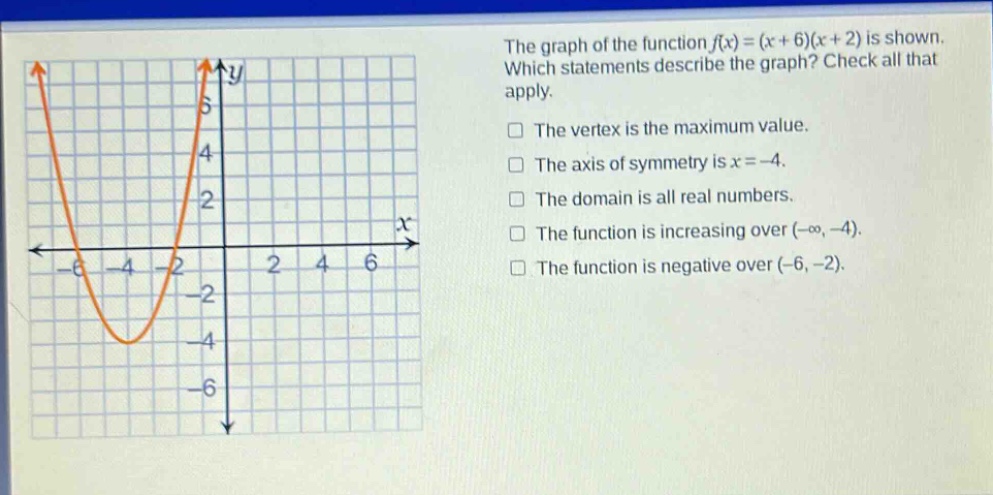
the graph of the function f(x)=(x + 6)(x + 2) is shown. which statements describe the graph? check all that apply. the vertex is the maximum value. the axis of symmetry is x=-4. the domain is all real numbers. the function is increasing over (-∞,-4). the function is negative over (-6,-2).
Answer
Explanation:
Step1: Expand the function
$f(x)=(x + 6)(x + 2)=x^{2}+8x + 12$. For a quadratic function $y = ax^{2}+bx + c$ ($a\neq0$), here $a = 1$, $b = 8$, $c = 12$.
Step2: Find the axis - of - symmetry
The formula for the axis of symmetry of a quadratic function $y=ax^{2}+bx + c$ is $x=-\frac{b}{2a}$. Substituting $a = 1$ and $b = 8$ gives $x=-\frac{8}{2\times1}=-4$. So the axis of symmetry is $x = - 4$, and the second statement is correct.
Step3: Determine the nature of the vertex
Since $a = 1>0$, the parabola opens upward, and the vertex is the minimum value, so the first statement is incorrect.
Step4: Find the domain
The domain of a quadratic function is all real numbers. So the domain of $y=x^{2}+8x + 12$ is all real numbers, and the third statement is correct.
Step5: Analyze the increasing and decreasing intervals
For a parabola $y = ax^{2}+bx + c$ with $a>0$, it is decreasing on $(-\infty,-\frac{b}{2a})$ and increasing on $(-\frac{b}{2a},\infty)$. Here, it is decreasing on $(-\infty,-4)$ and increasing on $(-4,\infty)$, so the fourth statement is incorrect.
Step6: Analyze where the function is negative
Set $y=(x + 6)(x + 2)=0$, the roots are $x=-6$ and $x=-2$. Since the parabola opens upward, the function is negative between the roots, i.e., over the interval $(-6,-2)$. So the fifth statement is correct.
Answer:
The axis of symmetry is $x=-4$. The domain is all real numbers. The function is negative over $(-6,-2)$.