the graph of the function f(x)=(x + 2)(x + 6) is shown below. what is true about the domain and range of the…
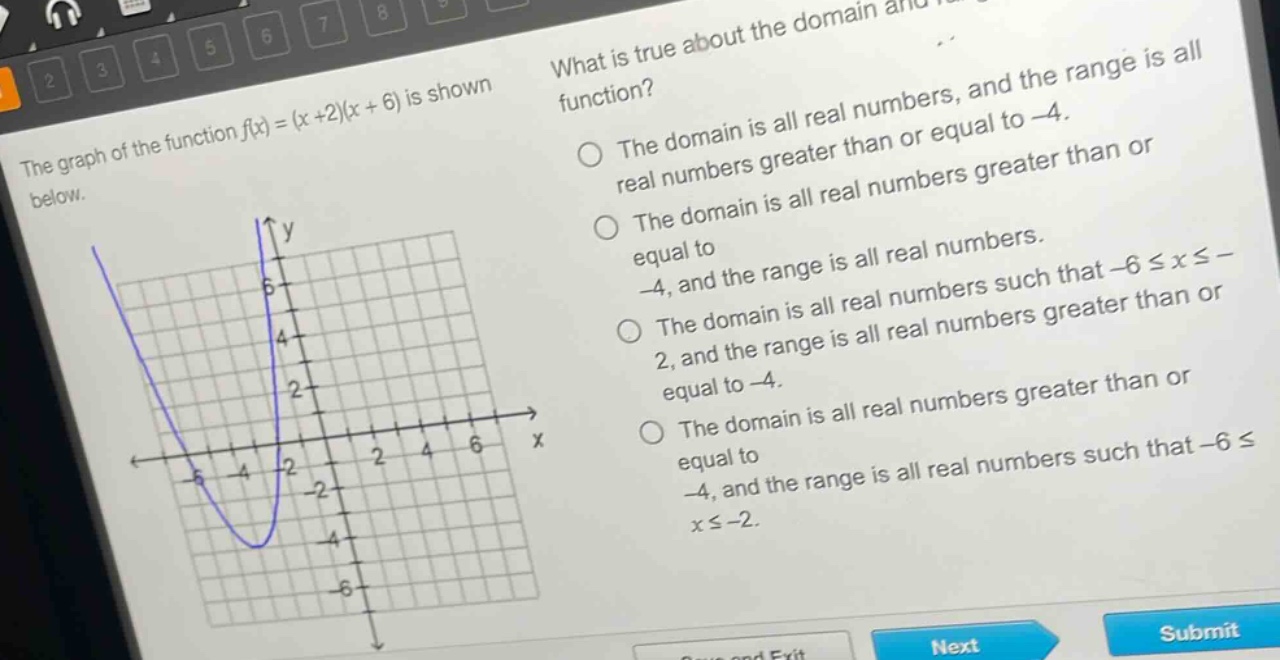
the graph of the function f(x)=(x + 2)(x + 6) is shown below. what is true about the domain and range of the function? the domain is all real numbers, and the range is all real numbers greater than or equal to -4. the domain is all real numbers greater than or equal to -4, and the range is all real numbers. the domain is all real numbers such that -6 ≤ x ≤ -2, and the range is all real numbers greater than or equal to -4. the domain is all real numbers greater than or equal to -4, and the range is all real numbers such that -6 ≤ x ≤ -2.
Answer
Answer:
The domain is all real numbers, and the range is all real numbers greater than or equal to - 4.
Explanation:
Step1: Recall domain definition
For polynomial functions like $f(x)=(x + 2)(x+6)=x^{2}+8x + 12$, the domain is all real numbers since we can substitute any real - valued $x$ into the function without causing any undefined operations (like division by zero or taking the square root of a negative number in the basic form of the function).
Step2: Find the vertex of the parabola
The function $y=x^{2}+8x + 12$ is a quadratic function in the form $y=ax^{2}+bx + c$ with $a = 1$, $b = 8$, and $c = 12$. The $x$ - coordinate of the vertex of a parabola $y=ax^{2}+bx + c$ is given by $x=-\frac{b}{2a}$. So, $x=-\frac{8}{2\times1}=-4$.
Step3: Find the $y$ - value of the vertex
Substitute $x=-4$ into the function $y=(-4)^{2}+8\times(-4)+12=16-32 + 12=-4$. Since $a = 1>0$, the parabola opens upward. So the range is all real numbers $y\geq - 4$.