the graph of the function f(x)=-(x + 3)(x - 1) is shown below. what is true about the domain and range of…
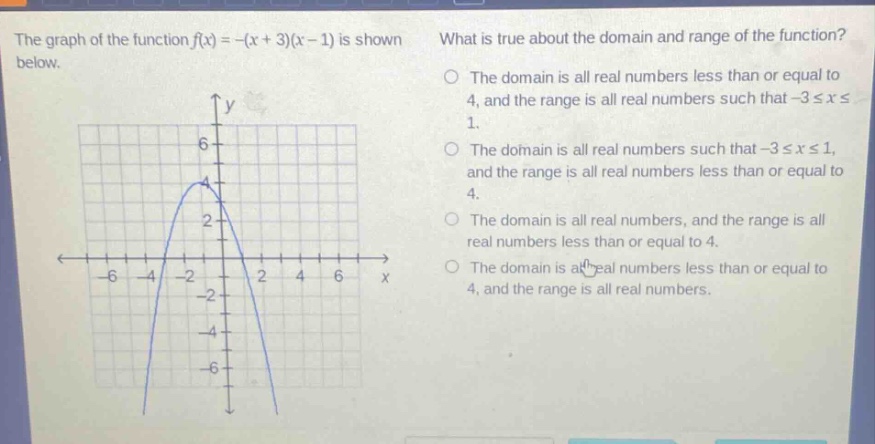
the graph of the function f(x)=-(x + 3)(x - 1) is shown below. what is true about the domain and range of the function? the domain is all real numbers less than or equal to 4, and the range is all real numbers such that -3≤x≤1. the domain is all real numbers such that -3≤x≤1, and the range is all real numbers less than or equal to 4. the domain is all real numbers, and the range is all real numbers less than or equal to 4. the domain is all real numbers less than or equal to 4, and the range is all real numbers.
Answer
Explanation:
Step1: Recall domain - definition
The domain of a polynomial function is the set of all real numbers. The function $f(x)=-(x + 3)(x - 1)=-x^{2}-2x + 3$ is a quadratic polynomial, so the domain is all real numbers.
Step2: Find the vertex of the parabola
For a quadratic function in the form $y = ax^{2}+bx + c$ (here $a=-1$, $b=-2$, $c = 3$), the $x$-coordinate of the vertex is $x=-\frac{b}{2a}=-\frac{-2}{2\times(-1)}=-1$. Substitute $x = - 1$ into the function: $y=-(-1 + 3)(-1 - 1)=-2\times(-2)=4$. Since $a=-1<0$, the parabola opens downwards. So the maximum value of the function is $y = 4$, and the range is all real numbers less than or equal to 4.
Answer:
The domain is all real numbers, and the range is all real numbers less than or equal to 4.