how is the graph of $y = \\log(x)$ transformed to produce the graph of $y = \\log(2x)+3$?\nit is stretched…
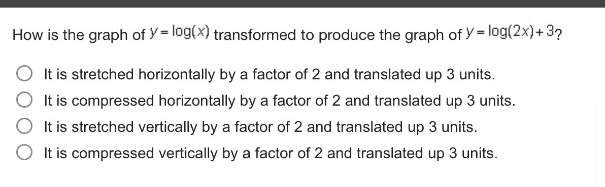
how is the graph of $y = \\log(x)$ transformed to produce the graph of $y = \\log(2x)+3$?\nit is stretched horizontally by a factor of 2 and translated up 3 units.\nit is compressed horizontally by a factor of 2 and translated up 3 units.\nit is stretched vertically by a factor of 2 and translated up 3 units.\nit is compressed vertically by a factor of 2 and translated up 3 units.
Answer
Explanation:
Step1: Analyze horizontal transformation
For the function $y = \log(x)$ to $y=\log(2x)$, when we have a transformation of the form $y = f(bx)$ where $b> 1$, the graph of $y = f(x)$ is compressed horizontally by a factor of $\frac{1}{b}$. Here $b = 2$, so the graph of $y=\log(x)$ is compressed horizontally by a factor of $\frac{1}{2}$ (or a factor of 2 in the sense of compression).
Step2: Analyze vertical transformation
For the transformation from $y=\log(2x)$ to $y=\log(2x)+3$, when we have a transformation of the form $y = f(x)+k$ where $k>0$, the graph of $y = f(x)$ is translated up by $k$ units. Here $k = 3$, so the graph is translated up 3 units.
Answer:
It is compressed horizontally by a factor of 2 and translated up 3 units.