which could be the graph of $f(x)=|x - h|+k$ if $h$ and $k$ are both positive?
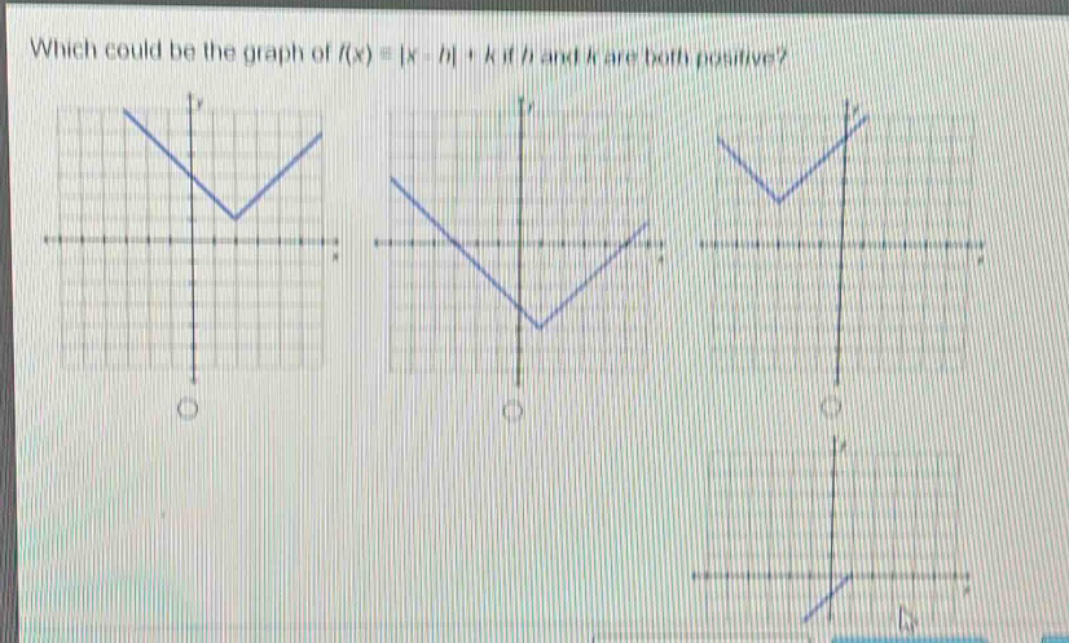
which could be the graph of $f(x)=|x - h|+k$ if $h$ and $k$ are both positive?
Answer
Answer:
The graph of (y = |x - h|+k) with (h>0) and (k > 0) is the graph of (y=|x|) shifted (h) units to the right and (k) units up. The vertex of the absolute - value function (y = |x|) is ((0,0)), and for the function (y=|x - h|+k), the vertex is ((h,k)). So the graph with the vertex in the first - quadrant (since (h>0,k > 0)) is the correct one. Without seeing the specific options clearly, in general, the graph of (y = |x - h|+k) ((h>0,k>0)) will have a "V" shape with its lowest point (vertex) at the point ((h,k)) where both (x = h>0) and (y=k > 0).
Explanation:
Step1: Recall absolute - value function properties
The parent function is (y = |x|), which has a vertex at ((0,0)) and a "V" shape.
Step2: Analyze horizontal shift
The transformation (y=|x - h|) shifts the graph of (y = |x|) (h) units to the right when (h>0).
Step3: Analyze vertical shift
The transformation (y=|x - h|+k) shifts the graph of (y = |x - h|) (k) units up when (k>0). So the vertex of (y = |x - h|+k) is ((h,k)) which is in the first quadrant when (h>0) and (k>0).