the graph represents a system of inequalities for the scenario where x is the number of confirmed parties on…
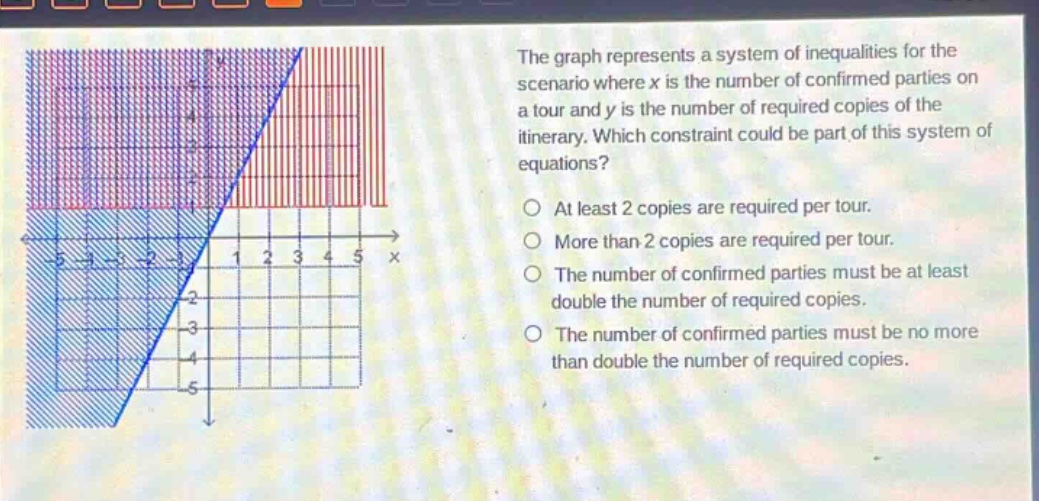
the graph represents a system of inequalities for the scenario where x is the number of confirmed parties on a tour and y is the number of required copies of the itinerary. which constraint could be part of this system of equations?\nat least 2 copies are required per tour.\nmore than 2 copies are required per tour.\nthe number of confirmed parties must be at least double the number of required copies.\nthe number of confirmed parties must be no more than double the number of required copies.
Answer
Explanation:
Step1: Analyze the graph
The line in the graph has a positive - slope. The shaded region is below the line. If we assume the equation of the line is in the form (y = mx + b) (where (m) is the slope and (b) is the y - intercept), the inequality represented by the shaded region is (y\leq mx + b). This implies a relationship where (y) (number of required copies of the itinerary) and (x) (number of confirmed parties) are related such that (x) is somehow limiting (y).
Step2: Evaluate each option
- Option 1: "At least 2 copies are required per tour" would be (y\geq2), which is a horizontal line and not related to the slanted line in the graph.
- Option 2: "More than 2 copies are required per tour" would be (y > 2), which is also a horizontal - line related inequality and not related to the slanted line in the graph.
- Option 3: "The number of confirmed parties must be at least double the number of required copies" would be (x\geq2y) or (y\leq\frac{1}{2}x), which is consistent with the shaded region being below a line with a positive slope.
- Option 4: "The number of confirmed parties must be no more than double the number of required copies" would be (x\leq2y) or (y\geq\frac{1}{2}x), but our shaded region is below the line, so this is incorrect.
Answer:
The number of confirmed parties must be at least double the number of required copies.