the graph of $g(x)$ is the result of translating the graph of $f(x)=\\left(\\frac{1}{2}\\right)^x$ three…
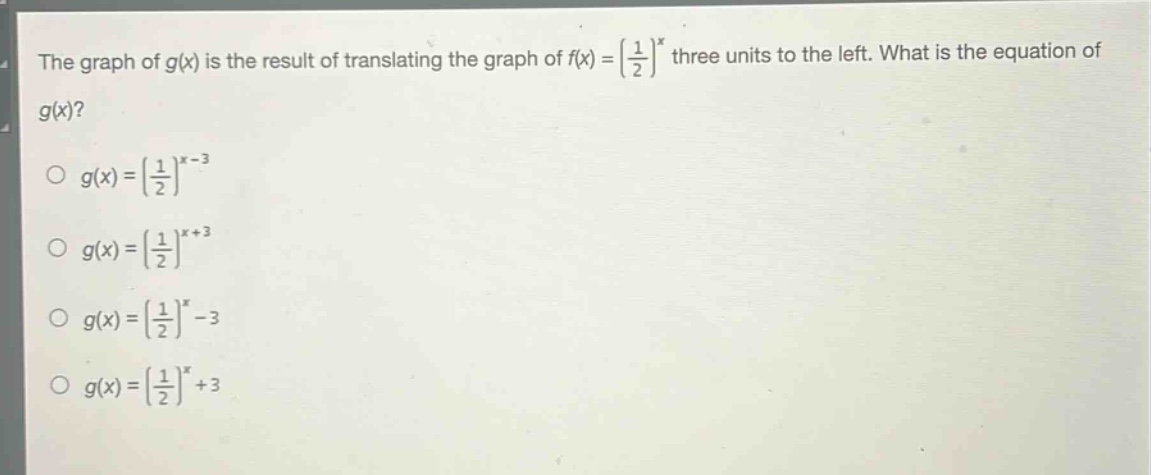
the graph of $g(x)$ is the result of translating the graph of $f(x)=\\left(\\frac{1}{2}\\right)^x$ three units to the left. what is the equation of $g(x)$?\n$g(x)=\\left(\\frac{1}{2}\\right)^{x - 3}$\n$g(x)=\\left(\\frac{1}{2}\\right)^{x+3}$\n$g(x)=\\left(\\frac{1}{2}\\right)^x-3$\n$g(x)=\\left(\\frac{1}{2}\\right)^x + 3$
Answer
Explanation:
Step1: Recall horizontal - shift rule
For a function $y = f(x)$, a horizontal shift of $h$ units to the left is given by the transformation $y=f(x + h)$.
Step2: Identify the function and the shift amount
We have $f(x)=\left(\frac{1}{2}\right)^x$ and the shift $h = 3$ units to the left. Substitute $x$ with $x+3$ in $f(x)$. So $g(x)=\left(\frac{1}{2}\right)^{x + 3}$.
Answer:
$g(x)=\left(\frac{1}{2}\right)^{x + 3}$