(a) the graph of y = f(x) is shown. draw the graph of y = f(-x).
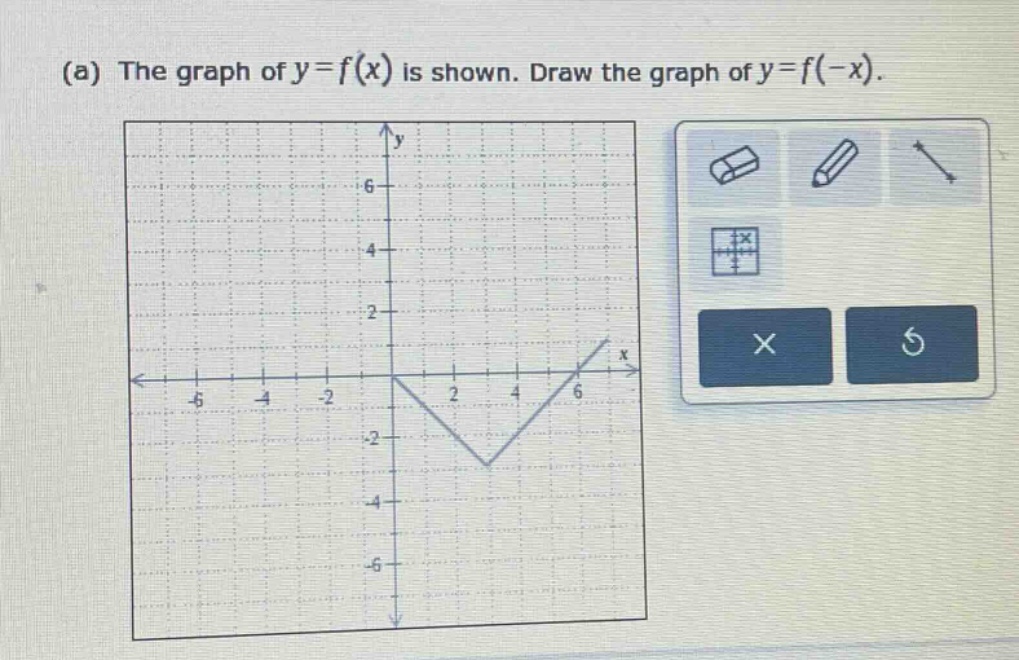
(a) the graph of y = f(x) is shown. draw the graph of y = f(-x).
Answer
Explanation:
Step1: Recall transformation rule
The graph of $y = f(-x)$ is the reflection of the graph of $y = f(x)$ about the $y$-axis.
Step2: Reflect key - points
For each point $(x,y)$ on the graph of $y = f(x)$, the corresponding point on the graph of $y = f(-x)$ is $(-x,y)$. For example, if there is a point $(2, - 3)$ on $y = f(x)$, then the point $(-2,-3)$ will be on $y = f(-x)$. Reflect all the key - points (such as the vertices of the shape in the graph) about the $y$-axis and then connect them to form the new graph.
Answer:
Draw the reflection of the given graph about the y - axis.