the graph shows that $f(x)=\\left(\\frac{1}{3}\\right)^x$ is translated horizontally and vertically to get…
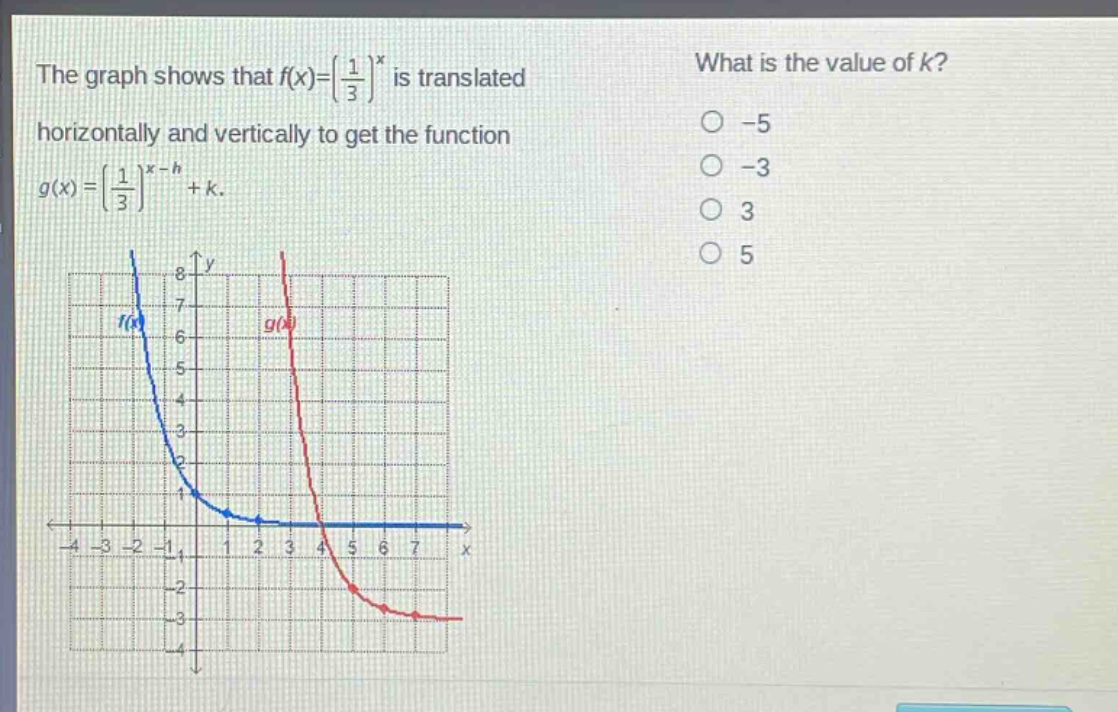
the graph shows that $f(x)=\\left(\\frac{1}{3}\\right)^x$ is translated horizontally and vertically to get the function $g(x)=\\left(\\frac{1}{3}\\right)^{x - h}+k$. what is the value of $k$? -5 -3 3 5
Answer
Explanation:
Step1: Recall vertical - translation rule
For an exponential function (y = a^{x}) translated to (y=a^{x - h}+k), the value of (k) represents the vertical translation. If (k>0), the graph is shifted up by (k) units, and if (k < 0), the graph is shifted down by (|k|) units.
Step2: Identify a key - point on (f(x)) and (g(x))
The (y) - intercept of (f(x)=\left(\frac{1}{3}\right)^{x}) is (f(0)=\left(\frac{1}{3}\right)^{0}=1) (when (x = 0), (y = 1)). Let's find the corresponding point on (g(x)=\left(\frac{1}{3}\right)^{x - h}+k). From the graph, when (x) is such that the shape of the graph is similar to the (y) - intercept of (f(x)) (a key - point for comparison), the (y) - value of (g(x)) is (y=- 3).
Step3: Calculate (k)
We know that the vertical translation from (y = 1) (of (f(x))) to (y=-3) (of (g(x))) is given by (k). Using the formula for vertical translation (y_{new}=y_{old}+k), substituting (y_{new}=-3) and (y_{old}=1), we get (-3=1 + k). Solving for (k): [k=-3 - 1=-4] However, if we assume we are looking at the general form of vertical shift and use another approach. The horizontal asymptote of (f(x)=\left(\frac{1}{3}\right)^{x}) is (y = 0), and the horizontal asymptote of (g(x)=\left(\frac{1}{3}\right)^{x - h}+k) is (y=k). From the graph, the horizontal asymptote of (g(x)) is (y=-3). So (k=-3).
Answer:
-3