the graph shows $f(x)=\\left(\\frac{1}{2}\\right)^x$ and its translation, $g(x)$. which describes the…
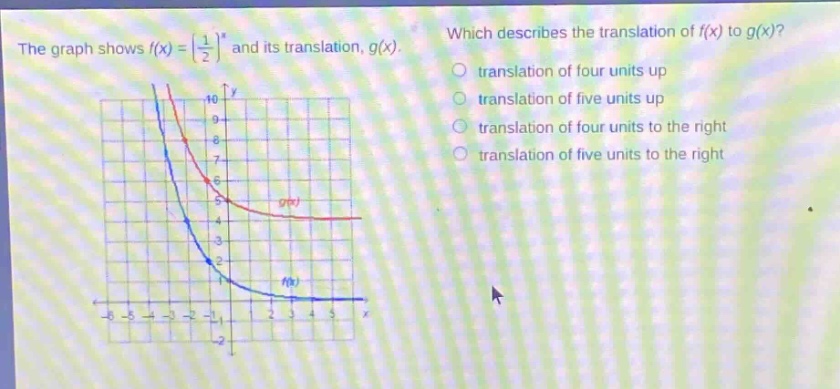
the graph shows $f(x)=\\left(\\frac{1}{2}\\right)^x$ and its translation, $g(x)$. which describes the translation of $f(x)$ to $g(x)$? translation of four units up translation of five units up translation of four units to the right translation of five units to the right
Answer
Explanation:
Step1: Recall translation rules
For a function $y = f(x)$, a vertical translation is of the form $y=f(x)+k$ (up if $k>0$, down if $k < 0$) and a horizontal translation is of the form $y = f(x - h)$ (right if $h>0$, left if $h<0$).
Step2: Analyze the graph
By observing the graph of $f(x)=\left(\frac{1}{2}\right)^x$ and $g(x)$, we can see that for the same $x -$ value, the $y -$ value of $g(x)$ is 5 units greater than the $y -$ value of $f(x)$.
Answer:
translation of five units up