the graph shows a logarithmic function f. what do f and the function g(x) = log₆x have in common? select all…
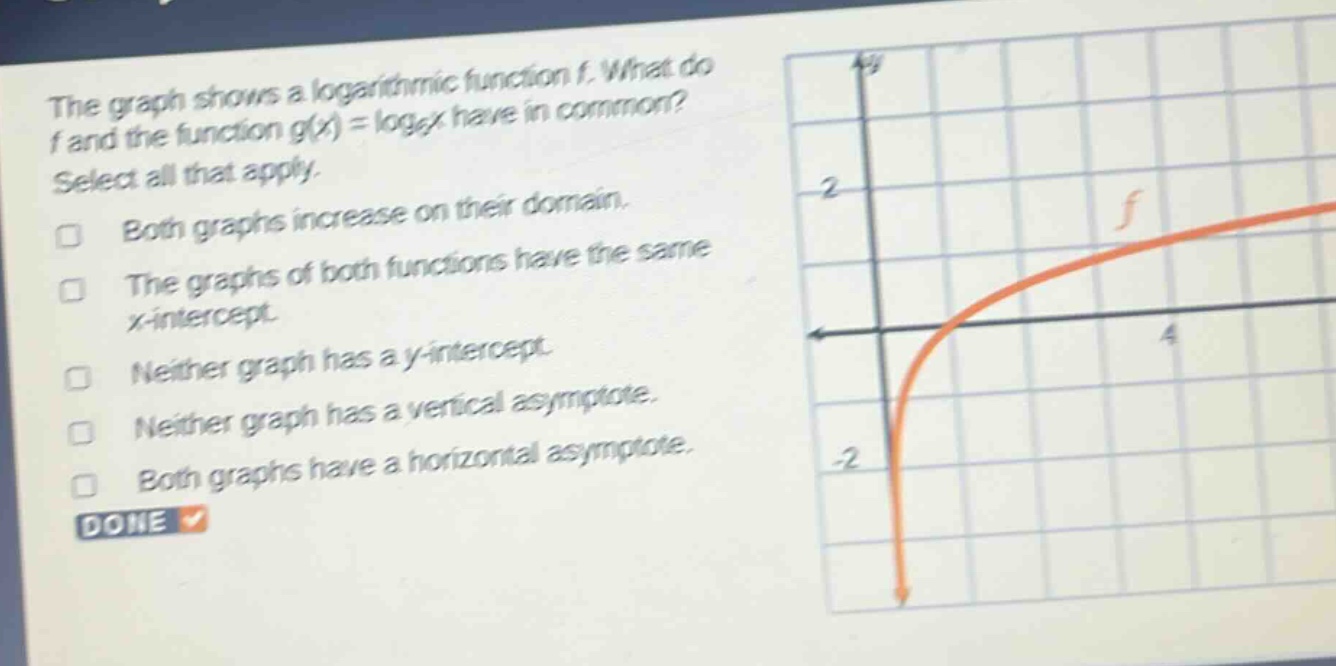
the graph shows a logarithmic function f. what do f and the function g(x) = log₆x have in common? select all that apply. both graphs increase on their domain. the graphs of both functions have the same x - intercept. neither graph has a y - intercept. neither graph has a vertical asymptote. both graphs have a horizontal asymptote. done
Answer
Brief Explanations:
- Crecimiento: Las funciones logarítmicas $y = \log_{a}x$ con $a>1$ son crecientes en su dominio $(0,+\infty)$. Si la función $f$ es logarítmica y $a > 1$, también crece en su dominio.
- Intersección con el eje - x: Para $y=\log_{a}x$, el $x$-intercept se obtiene al hacer $y = 0$. Entonces, $\log_{a}x=0$ implica $x = 1$. Sin más información sobre $f$, no podemos asegurar que tenga el mismo $x$-intercept.
- Intersección con el eje - y: La función $y=\log_{a}x$ no está definida para $x = 0$, por lo que no tiene $y$-intercept. Lo mismo aplica para cualquier función logarítmica $f$ ya que su dominio es $x>0$.
- Asíntota vertical: La función $y=\log_{a}x$ tiene una asíntota vertical en $x = 0$.
- Asíntota horizontal: Las funciones logarítmicas no tienen asíntotas horizontales.
Answer:
- Both graphs increase on their domain.
- Neither graph has a y - intercept.