the graph shows f(x) = (1/2)^x and its translation, g(x). which describes the translation of f(x) to g(x)…
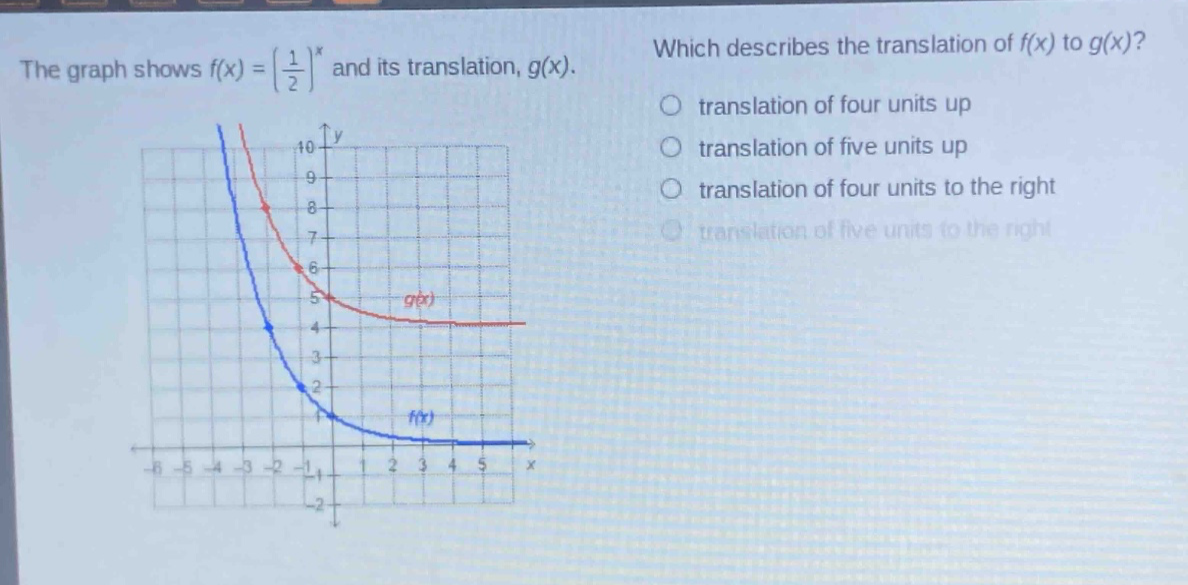
the graph shows f(x) = (1/2)^x and its translation, g(x). which describes the translation of f(x) to g(x)? translation of four units up translation of five units up translation of four units to the right translation of five units to the right
Answer
Explanation:
Step1: Recall translation rules
Vertical translation: $y = f(x)+k$ moves $f(x)$ up ($k>0$) or down ($k < 0$) by $|k|$ units. Horizontal translation: $y=f(x - h)$ moves $f(x)$ right ($h>0$) or left ($h < 0$) by $|h|$ units.
Step2: Analyze the graph
The $y$-intercept of $f(x)=\left(\frac{1}{2}\right)^x$ is at $(0, 1)$ (when $x = 0$, $y=1$). The $y$-intercept of $g(x)$ is at $(0,5)$. The value of $y$ for $g(x)$ is 4 units greater than the value of $y$ for $f(x)$ at $x = 0$. And the shape of the curve is not shifted horizontally. So it is a vertical - shift.
Answer:
translation of four units up