the graph shows $g(x)$, which is a translation of $f(x) = x^2$. write the function rule for $g(x)$.\nwrite…
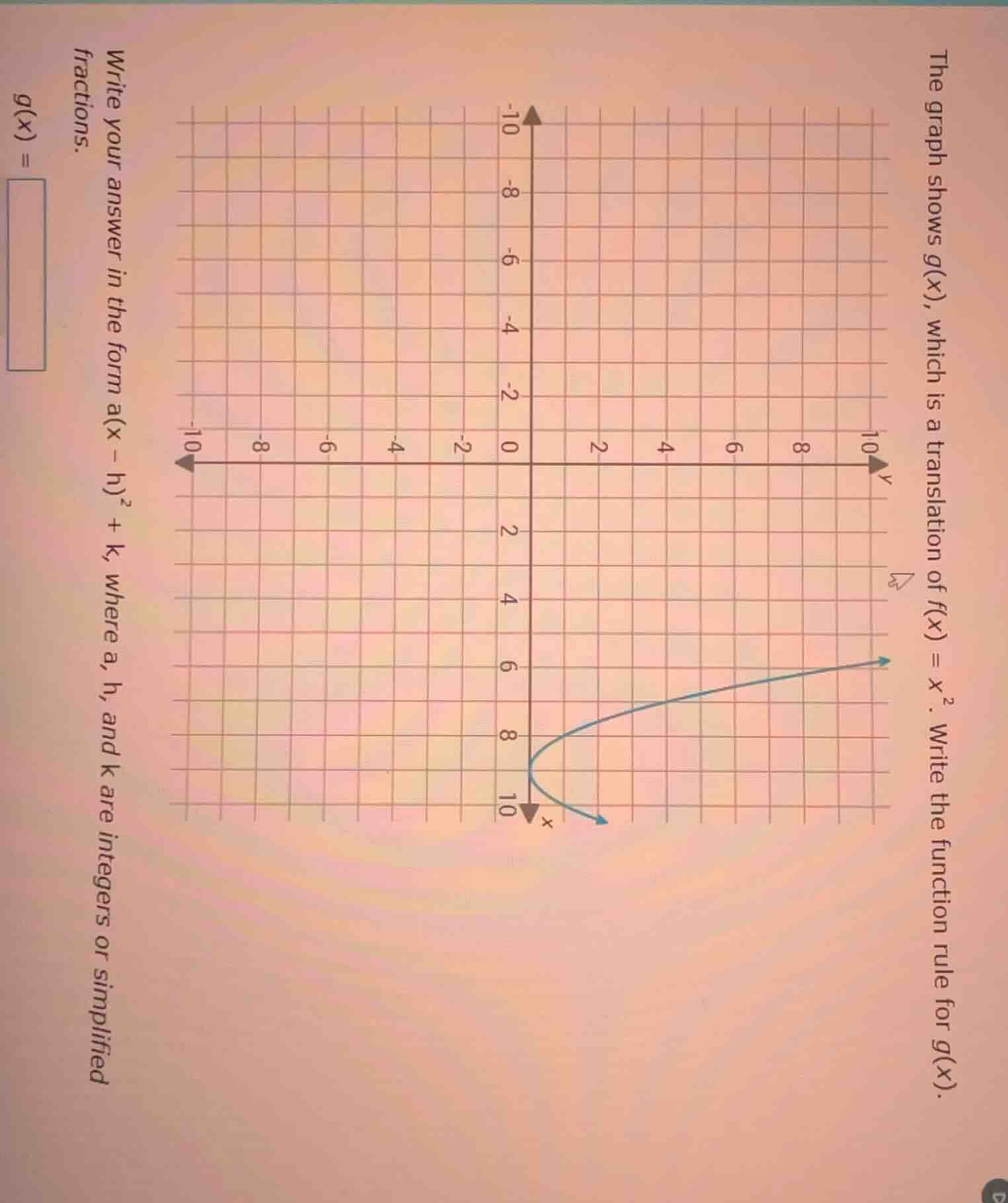
the graph shows $g(x)$, which is a translation of $f(x) = x^2$. write the function rule for $g(x)$.\nwrite your answer in the form $a(x - h)^2 + k$, where $a$, $h$, and $k$ are integers or simplified fractions.\n$g(x) =$
Answer
Explanation:
Step1: Identify the vertex from the graph
The vertex $(h, k)$ is the minimum point, located at $(1, 9)$.
Step2: Select another point on the parabola
The graph passes through the point $(3, 8)$.
Step3: Substitute values into the vertex form
Substitute $(h, k) = (1, 9)$ and $(x, y) = (3, 8)$ into $y = a(x - h)^2 + k$. $$8 = a(3 - 1)^2 + 9$$
Step4: Solve for the coefficient $a$
Simplify the equation to find the value of $a$. $$8 = 4a + 9 \implies -1 = 4a \implies a = -\frac{1}{4}$$
Step5: Write the final function rule
Substitute $a$, $h$, and $k$ back into the vertex form. $$g(x) = -\frac{1}{4}(x - 1)^2 + 9$$
Answer:
$g(x) = -\frac{1}{4}(x - 1)^2 + 9$