the graph shows g(x), which is a translation of f(x) = x². write the function rule for g(x). write your…
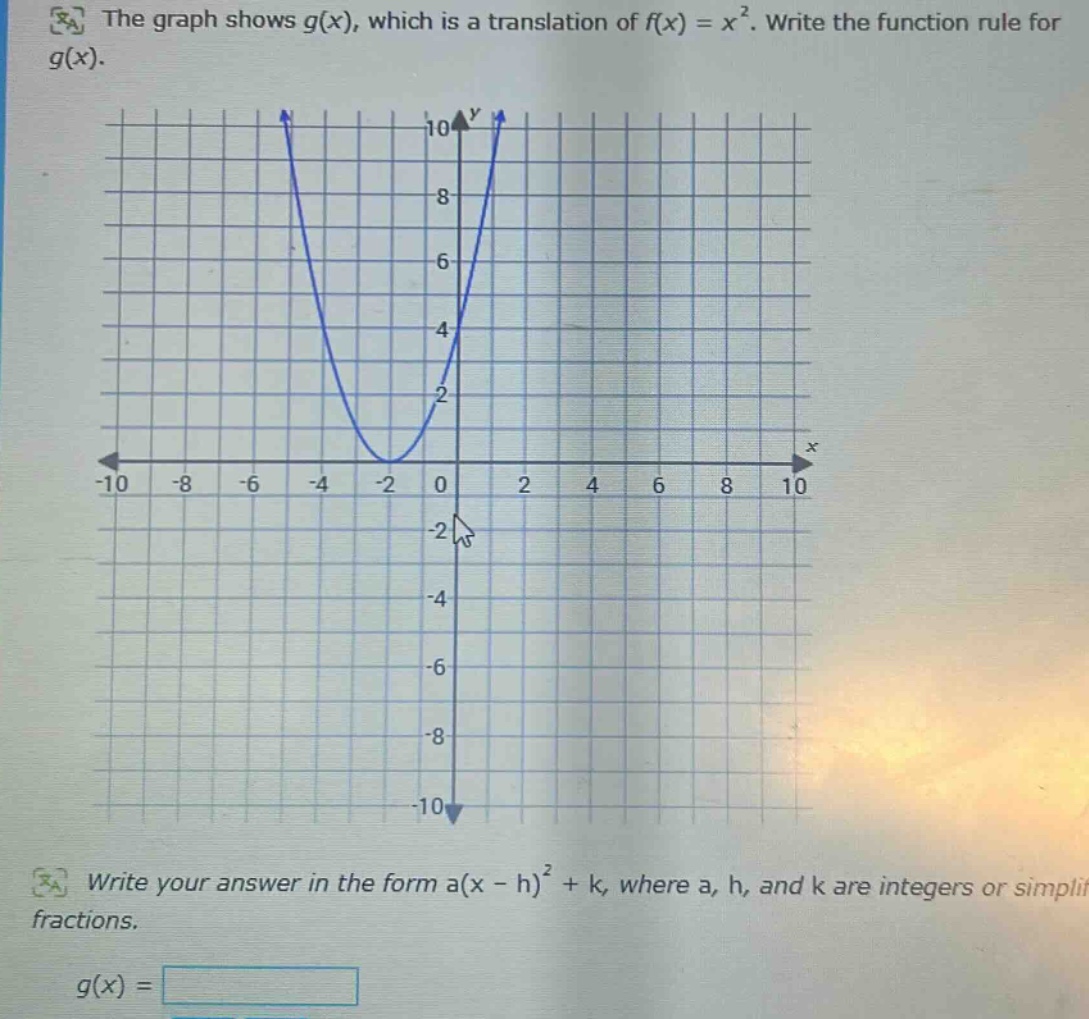
the graph shows g(x), which is a translation of f(x) = x². write the function rule for g(x). write your answer in the form a(x - h)² + k, where a, h, and k are integers or simplified fractions. g(x) =
Answer
Explanation:
Step1: Identify the vertex form of a quadratic function
The vertex - form of a quadratic function is $y = a(x - h)^2 + k$, where $(h,k)$ is the vertex of the parabola. For the parent function $f(x)=x^{2}$, $a = 1$, $h = 0$, and $k = 0$.
Step2: Determine the vertex of $g(x)$
From the graph, the vertex of the parabola $g(x)$ is at the point $(- 2,0)$. So, $h=-2$ and $k = 0$.
Step3: Determine the value of $a$
Since the shape of the parabola of $g(x)$ is the same as that of $f(x)=x^{2}$, the value of $a$ remains $1$ (no vertical stretch or compression).
Step4: Write the function rule for $g(x)$
Substitute $a = 1$, $h=-2$, and $k = 0$ into the vertex - form $y=a(x - h)^2 + k$. We get $g(x)=1\times(x-(-2))^{2}+0=(x + 2)^{2}$.
Answer:
$g(x)=(x + 2)^{2}$