which is the graph of the system of inequalities $ygeq\frac{4}{5}x - \frac{1}{5}$ and $yleq2x + 6$
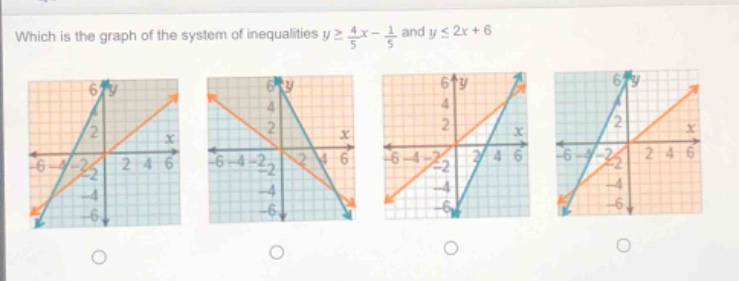
which is the graph of the system of inequalities $ygeq\frac{4}{5}x - \frac{1}{5}$ and $yleq2x + 6$
Answer
Explanation:
Step 1: Identify the boundary lines and their slopes/intercepts
First inequality: ( y \geq \frac{4}{5}x - \frac{1}{5} ) has a slope of ( \frac{4}{5} ) and y-intercept ( -\frac{1}{5} ).
Second inequality: ( y \leq 2x + 6 ) has a slope of ( 2 ) and y-intercept ( 6 ).
Step 2: Determine shading direction for each inequality
For ( y \geq \frac{4}{5}x - \frac{1}{5} ), shade above the line.
For ( y \leq 2x + 6 ), shade below the line.
Step 3: Check intersection and graph orientation
Find intersection by solving ( \frac{4}{5}x - \frac{1}{5} = 2x + 6 ):
( \frac{4}{5}x - 2x = 6 + \frac{1}{5} ) → ( -\frac{6}{5}x = \frac{31}{5} ) → ( x = -\frac{31}{6} ), ( y = 2(-\frac{31}{6}) + 6 = -\frac{31}{3} + \frac{18}{3} = -\frac{13}{3} ).
Correct graph shows both lines with proper slopes/intercepts and shading between them.
Answer:
The correct graph is the one where the blue line (first inequality) has a shallower slope than the orange line (second inequality), with shading above the blue line and below the orange line, intersecting at a point in the third quadrant. (Assuming the fourth option in the original image matches these criteria, but since options are labeled with circles without identifiers, the precise answer depends on visual confirmation of slope/shading direction as described.)
(Note: Since the original problem includes image options but they aren't numbered here, the final answer would typically select the option matching the described slope/shading characteristics. In a standard setup, this would correspond to the graph where the lighter shaded area is between the two lines, with the steeper line being ( y \leq 2x + 6 ) and the less steep line being ( y \geq \frac{4}{5}x - \frac{1}{5} ), shaded above the former and below the latter.)