how is the graph of $y=(x - 1)^2-3$ transformed to produce the graph of $y=\frac{1}{2}(x + 4)^2$?\nthe graph…
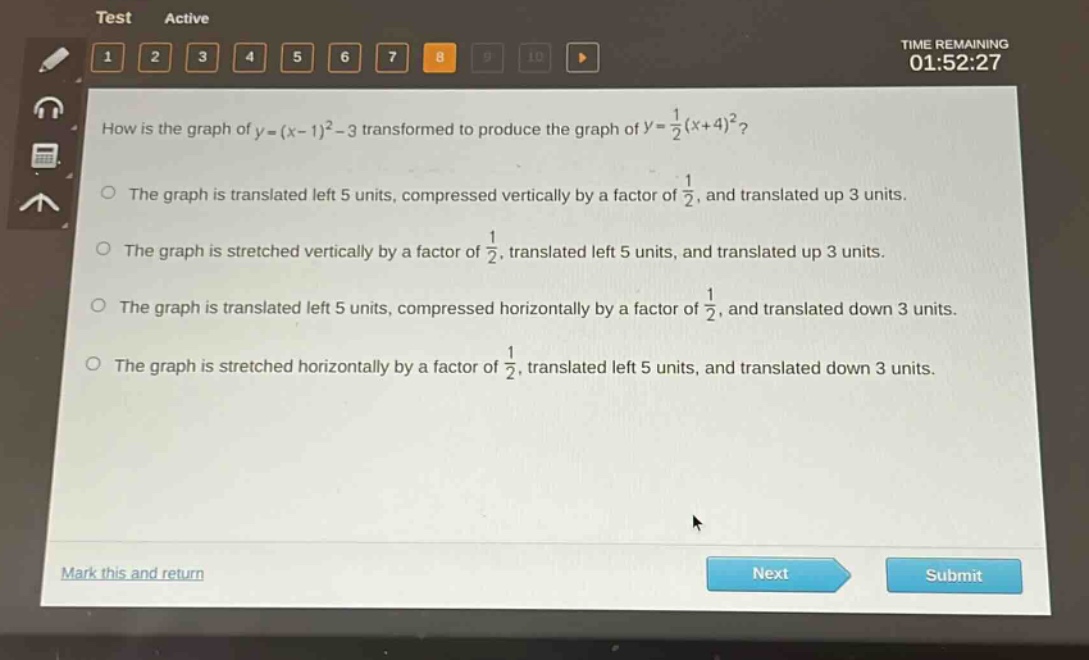
how is the graph of $y=(x - 1)^2-3$ transformed to produce the graph of $y=\frac{1}{2}(x + 4)^2$?\nthe graph is translated left 5 units, compressed vertically by a factor of $\frac{1}{2}$, and translated up 3 units.\nthe graph is stretched vertically by a factor of $\frac{1}{2}$, translated left 5 units, and translated up 3 units.\nthe graph is translated left 5 units, compressed horizontally by a factor of $\frac{1}{2}$, and translated down 3 units.\nthe graph is stretched horizontally by a factor of $\frac{1}{2}$, translated left 5 units, and translated down 3 units.
Answer
Explanation:
Step1: Analyze horizontal translation
For the quadratic - function form (y = a(x - h)^2+k), the original function is (y=(x - 1)^2-3) with (h_1 = 1) and the new function is (y=\frac{1}{2}(x + 4)^2) with (h_2=-4). The change in (x) is (\Delta x=h_2 - h_1=-4 - 1=-5), which means a left - shift of 5 units.
Step2: Analyze vertical transformation
The coefficient (a) of the original function is (a_1 = 1) and for the new function (a_2=\frac{1}{2}). Since (0\lt a_2\lt a_1), the graph is compressed vertically by a factor of (\frac{1}{2}).
Step3: Analyze vertical translation
The original function has (k_1=-3) and the new function has (k_2 = 0). The change in (y) is (\Delta y=k_2 - k_1=0-(-3)=3), which means a translation up 3 units.
Answer:
The graph is translated left 5 units, compressed vertically by a factor of (\frac{1}{2}), and translated up 3 units.