the graph of h(x) is a translation of f(x) = ∛x. which equation represents h(x)? o h(x) = ∛(x - 2) o h(x) =…
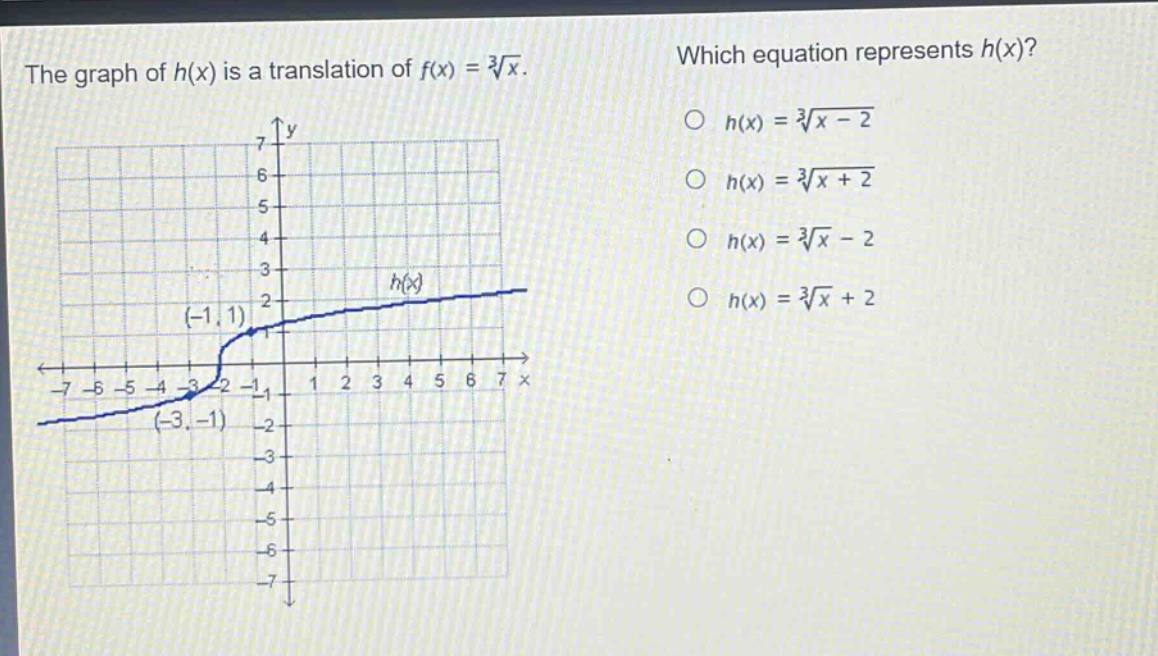
the graph of h(x) is a translation of f(x) = ∛x. which equation represents h(x)? o h(x) = ∛(x - 2) o h(x) = ∛(x + 2) o h(x) = ∛x - 2 o h(x) = ∛x + 2
Answer
Explanation:
Step1: Recall translation rules
For a function $y = f(x)$, a horizontal translation of $a$ units to the right is $y=f(x - a)$ and a vertical translation of $b$ units up is $y=f(x)+b$. The parent - function is $f(x)=\sqrt[3]{x}$. The point $(0,0)$ on $y = \sqrt[3]{x}$ is translated to $(- 2,0)$ on $h(x)$ (by observing the shape of the cube - root function and its position). This is a horizontal translation of 2 units to the left. The general form of a horizontal translation of the cube - root function $y=\sqrt[3]{x}$ is $y=\sqrt[3]{x + a}$ for a left - hand translation of $a$ units.
Step2: Check the options
We know that a left - hand translation of 2 units of $y = \sqrt[3]{x}$ gives $h(x)=\sqrt[3]{x + 2}$.
Answer:
$h(x)=\sqrt[3]{x + 2}$