the graphs of $f(x)=\\left(\\frac{2}{3}\\right)^x$ and $g(x)=\\left(\\frac{2}{3}\\right)^{x - 2}$ are shown…
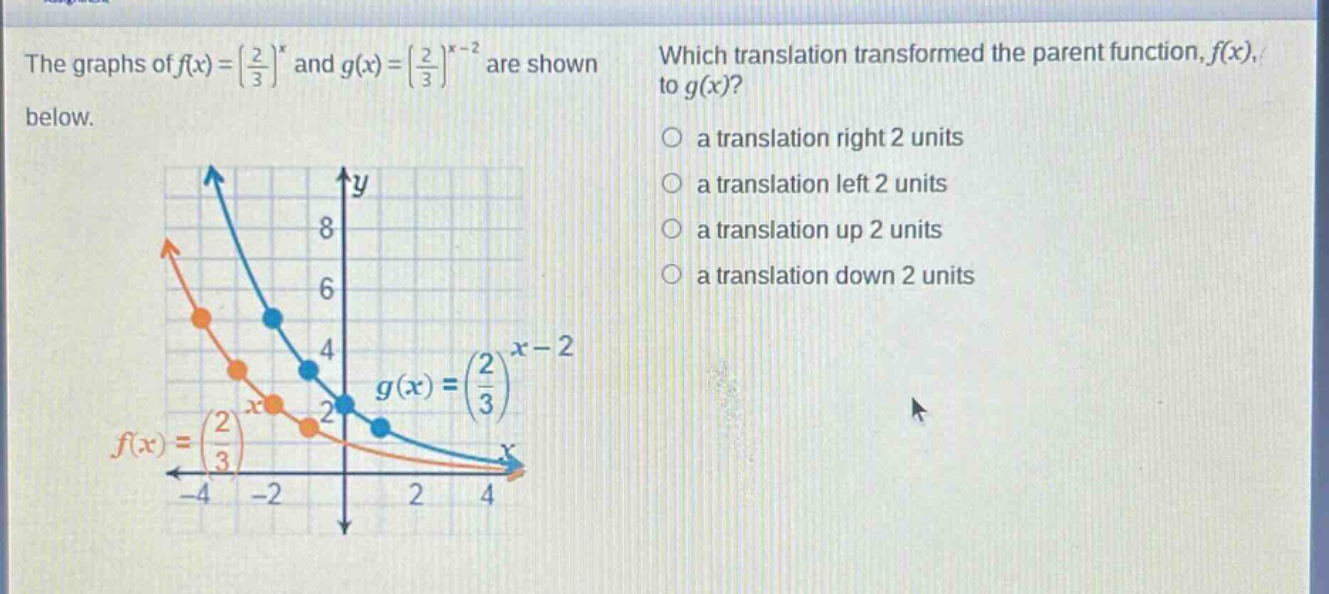
the graphs of $f(x)=\\left(\\frac{2}{3}\\right)^x$ and $g(x)=\\left(\\frac{2}{3}\\right)^{x - 2}$ are shown below. which translation transformed the parent function, $f(x)$, to $g(x)$? a translation right 2 units a translation left 2 units a translation up 2 units a translation down 2 units
Answer
Explanation:
Step1: Recall function - translation rule
For a function $y = f(x - h)+k$, a horizontal translation is given by the value of $h$ and a vertical translation is given by the value of $k$. If $h>0$, the graph of $y = f(x)$ is translated $h$ units to the right, and if $h < 0$, it is translated $|h|$ units to the left. If $k>0$, the graph is translated $k$ units up, and if $k < 0$, it is translated $|k|$ units down.
Step2: Compare $f(x)$ and $g(x)$
We have $f(x)=\left(\frac{2}{3}\right)^{x}$ and $g(x)=\left(\frac{2}{3}\right)^{x - 2}$. Comparing with the form $y = f(x - h)+k$, here $h = 2$ and $k=0$.
Answer:
A. a translation right 2 units