the graphs of f(x) = 5^x and its translation, g(x), are shown on the graph. what is the equation of g(x)…
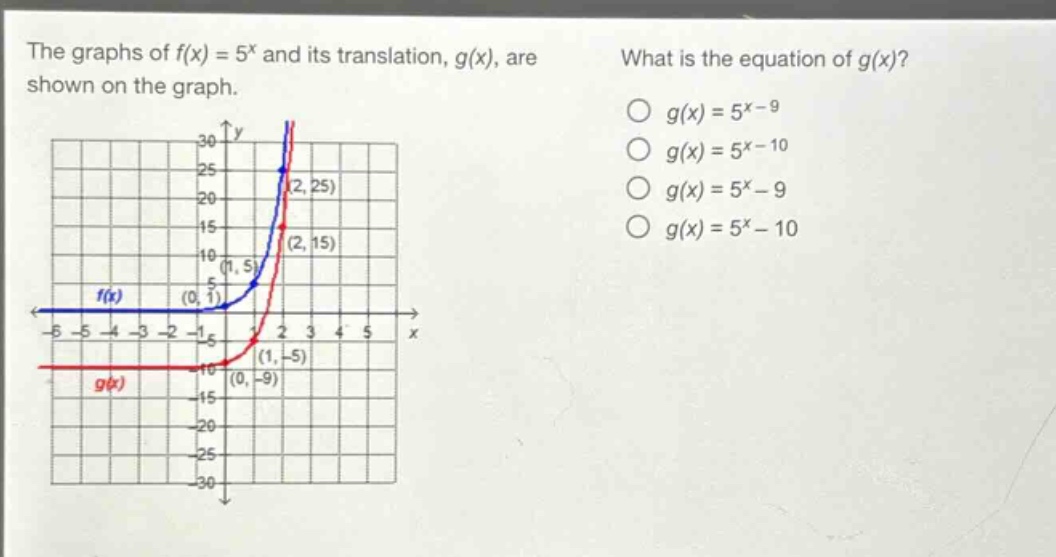
the graphs of f(x) = 5^x and its translation, g(x), are shown on the graph. what is the equation of g(x)? g(x) = 5^{x - 9} g(x) = 5^{x - 10} g(x) = 5^x - 9 g(x) = 5^x - 10
Answer
Explanation:
Step1: Identify the original function and a point on its graph.
The original function is $f(x) = 5^x$. From the graph, a point on $f(x)$ is $(0, 1)$. $$f(0) = 5^0 = 1$$
Step2: Identify the corresponding point on the translated function g(x).
From the graph, the point on $g(x)$ that corresponds to $(0, 1)$ on $f(x)$ is $(0, -9)$.
Step3: Determine the vertical translation.
The graph of $g(x)$ is obtained by shifting the graph of $f(x)$ vertically. The vertical shift is the difference in the y-coordinates of corresponding points. $$ \text{Vertical Shift} = y_{g} - y_{f} = -9 - 1 = -10 $$ This indicates a downward shift of 10 units.
Step4: Write the equation for the translated function g(x).
A vertical shift of $k$ units applied to $f(x)$ results in $g(x) = f(x) + k$. Here, $k = -10$. $$ g(x) = f(x) - 10 = 5^x - 10 $$
Answer:
$g(x) = 5^x - 10$