a group of children, adults, and senior citizens attended three different art exhibits that have different…
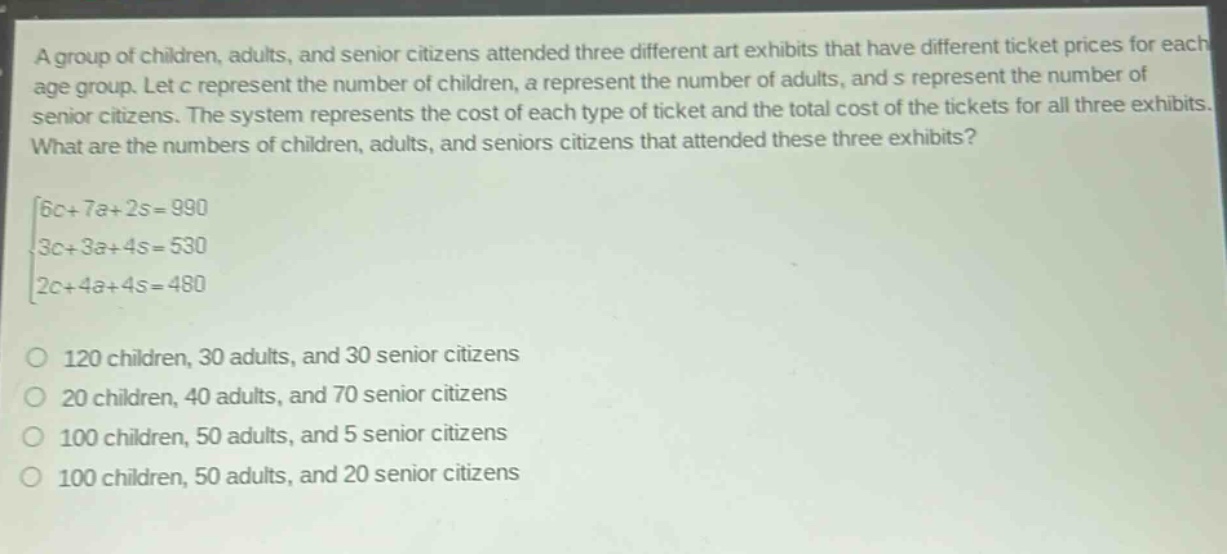
a group of children, adults, and senior citizens attended three different art exhibits that have different ticket prices for each age group. let c represent the number of children, a represent the number of adults, and s represent the number of senior citizens. the system represents the cost of each type of ticket and the total cost of the tickets for all three exhibits. what are the numbers of children, adults, and seniors citizens that attended these three exhibits?\n\\\\begin{cases}6c + 7a+2s = 990\\3c + 3a+4s = 530\\2c + 4a+4s = 480\\end{cases}\\\no 120 children, 30 adults, and 30 senior citizens\no 20 children, 40 adults, and 70 senior citizens\no 100 children, 50 adults, and 5 senior citizens\no 100 children, 50 adults, and 20 senior citizens
Answer
Explanation:
Step1: Substitute option values
For each option, substitute the values of (c), (a), and (s) into the first - equation (6c + 7a+2s=990).
Option 1: (c = 120), (a = 30), (s = 30)
[6\times120+7\times30 + 2\times30=720 + 210+60=990]
Option 2: (c = 20), (a = 40), (s = 70)
[6\times20+7\times40+2\times70=120 + 280+140=540\neq990]
Option 3: (c = 100), (a = 50), (s = 5)
[6\times100+7\times50+2\times5=600 + 350 + 10=960\neq990]
Option 4: (c = 100), (a = 50), (s = 20)
[6\times100+7\times50+2\times20=600+350 + 40=990] Since only options 1 and 4 satisfy the first equation, we check them in the second equation (3c + 3a+4s=530).
Step2: Check in second - equation
Option 1: (c = 120), (a = 30), (s = 30)
[3\times120+3\times30+4\times30=360+90 + 120=570\neq530]
Option 4: (c = 100), (a = 50), (s = 20)
[3\times100+3\times50+4\times20=300+150 + 80=530] Since option 4 satisfies the first two equations, we check it in the third equation (2c + 4a+4s=480).
Step3: Check in third - equation
For (c = 100), (a = 50), (s = 20) [2\times100+4\times50+4\times20=200+200 + 80=480]
Answer:
D. 100 children, 50 adults, and 20 senior citizens