a group of students is given a 10 by 10 grid to cut into individual unit squares. the challenge is to create…
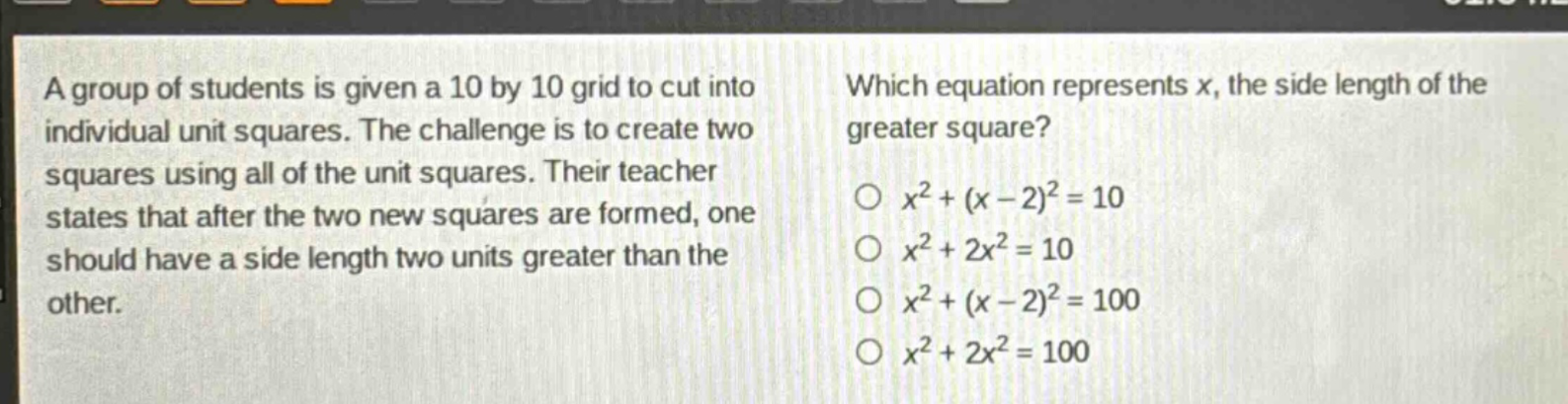
a group of students is given a 10 by 10 grid to cut into individual unit squares. the challenge is to create two squares using all of the unit squares. their teacher states that after the two new squares are formed, one should have a side length two units greater than the other. which equation represents x, the side length of the greater square? o $x^{2}+(x - 2)^{2}=10$ o $x^{2}+2x^{2}=10$ o $x^{2}+(x - 2)^{2}=100$ o $x^{2}+2x^{2}=100$
Answer
Explanation:
Step1: Calculate total unit - squares
The 10 by 10 grid has $10\times10 = 100$ unit - squares.
Step2: Set up the equation for the two squares
Let the side - length of the greater square be $x$ and the side - length of the smaller square be $x - 2$. The area of a square is given by $A=s^{2}$, where $s$ is the side - length. The sum of the areas of the two squares must equal the total number of unit - squares. So the equation is $x^{2}+(x - 2)^{2}=100$.
Answer:
C. $x^{2}+(x - 2)^{2}=100$