haji rows his canoe 10 mph in still water. he noticed one day that he could row 4 miles upstream in the same…
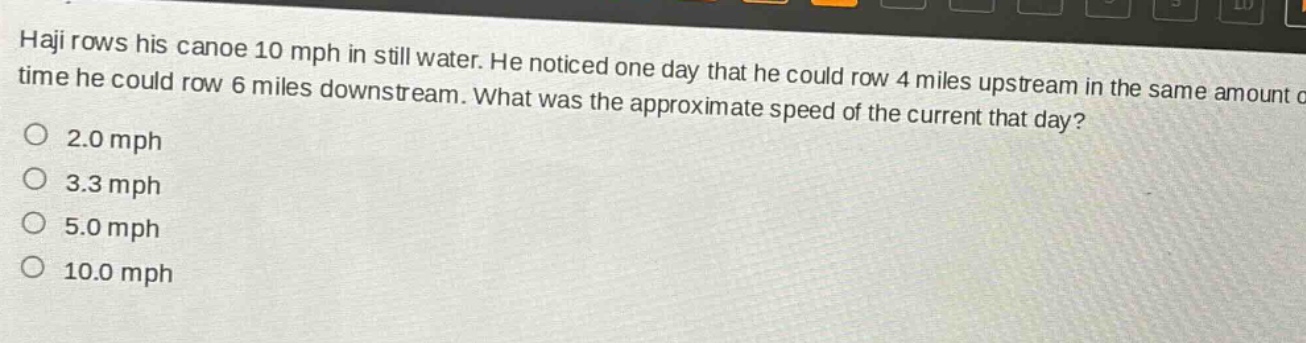
haji rows his canoe 10 mph in still water. he noticed one day that he could row 4 miles upstream in the same amount of time he could row 6 miles downstream. what was the approximate speed of the current that day?\n2.0 mph\n3.3 mph\n5.0 mph\n10.0 mph
Answer
Explanation:
Step1: Set up speed - time equations
Let the speed of the current be $x$ mph. The speed of the canoe upstream is $(10 - x)$ mph and downstream is $(10 + x)$ mph. Since time $t=\frac{d}{s}$ (where $d$ is distance and $s$ is speed), and the time upstream $t_{up}$ and downstream $t_{down}$ are equal, we have $\frac{4}{10 - x}=\frac{6}{10 + x}$.
Step2: Cross - multiply
Cross - multiplying the equation $\frac{4}{10 - x}=\frac{6}{10 + x}$ gives $4(10 + x)=6(10 - x)$.
Step3: Expand both sides
Expanding, we get $40+4x = 60-6x$.
Step4: Solve for $x$
Add $6x$ to both sides: $40 + 4x+6x=60-6x + 6x$, which simplifies to $40 + 10x=60$. Then subtract 40 from both sides: $10x=60 - 40$, so $10x = 20$. Divide both sides by 10: $x = 2$.
Answer:
A. 2.0 mph