half of the product of two consecutive numbers is 105. which equation can be used to solve for n, the…
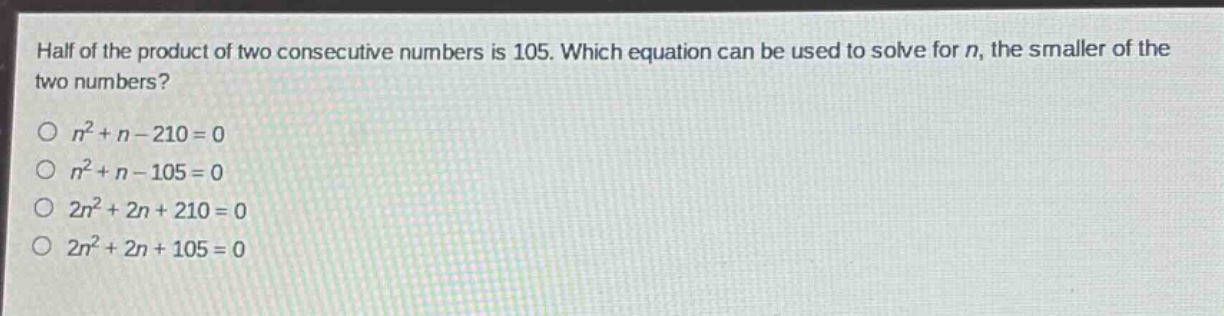
half of the product of two consecutive numbers is 105. which equation can be used to solve for n, the smaller of the two numbers?\n\n$n^{2}+n - 210 = 0$\n$n^{2}+n - 105 = 0$\n$2n^{2}+2n + 210 = 0$\n$2n^{2}+2n + 105 = 0$
Answer
Explanation:
Step1: Define the two consecutive numbers
Let the smaller number be $n$, then the larger consecutive number is $n + 1$.
Step2: Set up the equation based on the problem - statement
The product of the two consecutive numbers is $n(n + 1)$. Half of this product is 105, so we have the equation $\frac{n(n + 1)}{2}=105$.
Step3: Simplify the equation
Multiply both sides of the equation by 2 to get $n(n + 1)=210$. Expand the left - hand side: $n^{2}+n = 210$. Subtract 210 from both sides to set the equation equal to zero: $n^{2}+n−210 = 0$.
Answer:
$n^{2}+n - 210=0$