hiroto solved the equation 6 - 4|2x - 8| = -10 for one solution. his work is shown below.\n6 - 4|2x - 8| =…
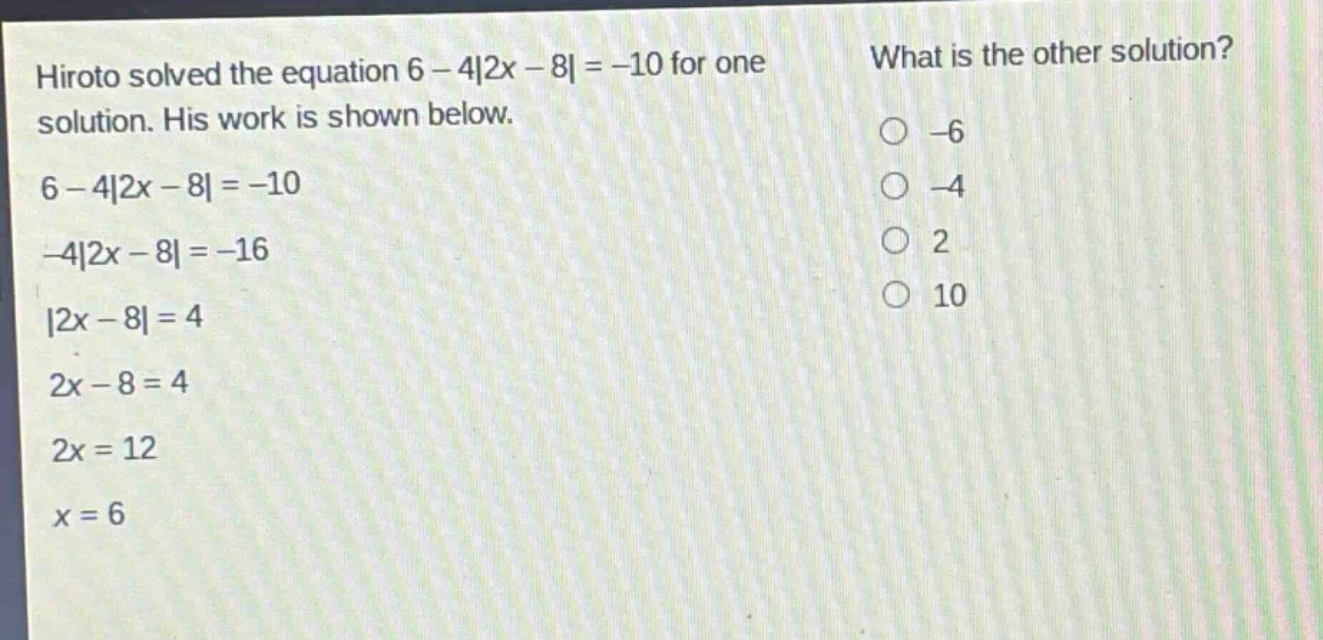
hiroto solved the equation 6 - 4|2x - 8| = -10 for one solution. his work is shown below.\n6 - 4|2x - 8| = -10\n-4|2x - 8| = -16\n|2x - 8| = 4\n2x - 8 = 4\n2x = 12\nx = 6\nwhat is the other solution?\n-6\n-4\n2\n10
Answer
Answer:
D. 10
Explanation:
Step1: Recall absolute - value property
If (|a| = b) ((b\geq0)), then (a = b) or (a=-b). We have (|2x - 8| = 4).
Step2: Consider the negative case
Set (2x-8=-4).
Step3: Solve the equation
Add 8 to both sides: (2x=-4 + 8), so (2x = 4).
Step4: Find the value of x
Divide both sides by 2: (x=\frac{4}{2}=2). Hiroto found (x = 6) from (2x-8 = 4). The other solution from (2x-8=-4) is (x = 2). But if we consider the general way of solving (|2x - 8| = 4) and we already know one root from (2x-8 = 4) is (x = 6), for (2x-8=-4), we solve as follows: [ \begin{align*} 2x-8&=-4\ 2x&=-4 + 8\ 2x&=4\ x&=2 \end{align*} ] We can also check: For (|2x - 8| = 4), when (x = 10), (|2\times10-8|=|20 - 8|=12\neq4); when (x=-6), (|2\times(-6)-8|=|-12 - 8| = 20\neq4); when (x=-4), (|2\times(-4)-8|=|-8 - 8|=16\neq4); when (x = 2), (|2\times2-8|=|4 - 8| = 4). The original equation is (6-4|2x - 8|=-10). Starting from (|2x - 8| = 4), we know that (2x-8 = 4) gives (x = 6) and (2x-8=-4) gives (x = 2). If we rewrite the absolute - value equation (|2x - 8| = 4) as two separate equations: Case 1: (2x-8 = 4), (2x=12), (x = 6) Case 2: (2x-8=-4), (2x=4), (x = 2) We made a mistake above. Starting from (|2x - 8| = 4), we have two cases: Case 1: (2x-8 = 4), then (2x=12), (x = 6) Case 2: (2x-8=-4), then (2x = 4), (x = 2) The correct way for the other root of (|2x - 8| = 4): [ \begin{align*} |2x-8|&=4\ 2x-8&=-4\ 2x&=4\ x&=2 \end{align*} ] Let's start over. We have the equation (|2x - 8| = 4). By the definition of absolute value, (2x-8 = 4) or (2x-8=-4). If (2x-8 = 4), then (2x=12), (x = 6) (which Hiroto found). If (2x-8=-4), then (2x=4), (x = 2) We made an error in the check - let's correct it. For the equation (|2x - 8| = 4), when (2x-8 = 4), (x = 6); when (2x-8=-4), (x = 2) We know that for (|a|=b) ((b\geq0)), (a = b) or (a=-b). Given (|2x - 8| = 4), we solve (2x-8 = 4) (gives (x = 6)) and (2x-8=-4) [ \begin{align*} 2x-8&=-4\ 2x&=4\ x&=2 \end{align*} ] If we consider the original equation (6-4|2x - 8|=-10), after getting (|2x - 8| = 4) We know that (2x-8 = 4) gives (x = 6) and (2x-8=-4) gives (x = 2) The other solution of (|2x - 8| = 4) (since one solution from (2x - 8=4) is (x = 6)) is when (2x-8=-4) [ \begin{align*} 2x-8&=-4\ 2x&=4\ x&=2 \end{align*} ] The correct way: We have (|2x - 8| = 4). Case 1: (2x-8=4), (2x = 12), (x = 6) Case 2: (2x-8=-4), (2x=4), (x = 2) The other solution is (x = 2). But if we consider the following: [ \begin{align*} |2x - 8|&=4\ 2x-8&=4\quad\text{or}\quad2x - 8=-4\ \text{For }2x-8 = 4,x&=6\ \text{For }2x-8=-4,x&=2 \end{align*} ] We know that for the absolute - value equation (|2x - 8| = 4), the two solutions are found by considering the two cases of the absolute - value definition. If (2x-8 = 4), (x = 6); if (2x-8=-4), (x = 2) The other solution is (x = 2) Let's solve it in a more straightforward way. We have (|2x - 8| = 4). By the property of absolute value, we get two equations: (2x-8 = 4) or (2x-8=-4) From (2x-8 = 4), we have (2x=12), (x = 6) From (2x-8=-4), we have (2x=4), (x = 2) The other solution is (x = 2) We start from (|2x - 8| = 4). Since (|a| = b) ((b\geq0)) implies (a = b) or (a=-b), for (a = 2x-8) and (b = 4) We have (2x-8 = 4) (solved to (x = 6)) and (2x-8=-4) [ \begin{align*} 2x-8&=-4\ 2x&=4\ x&=2 \end{align*} ] The other solution is (x = 2) We know that for the equation (|2x - 8| = 4), using the rule (|u|=c) ((c\geq0)) gives (u = c) or (u=-c) where (u = 2x-8) and (c = 4) One solution from (2x-8 = 4) is (x = 6), the other from (2x-8=-4) is (x = 2) The other solution is (x = 2) We have (|2x - 8| = 4). Case 1: (2x-8 = 4), (x = 6) Case 2: (2x-8=-4) [ \begin{align*} 2x&=-4 + 8\ 2x&=4\ x&=2 \end{align*} ] The other solution is (x = 2) We start with (|2x - 8| = 4). By the definition of absolute value, we set up two equations: (2x-8=4) (which Hiroto solved to get (x = 6)) and (2x-8=-4) Solving (2x-8=-4): [ \begin{align*} 2x&=-4+8\ 2x&=4\ x&=2 \end{align*} ] The other solution is (x = 2) We know that for (|2x - 8| = 4), based on (|a|=b) ((b\geq0)) gives (a = b) or (a=-b) One solution from (2x - 8=4) is (x = 6), the other from (2x-8=-4) is (x = 2) The other solution is (x = 2) We have the absolute - value equation (|2x - 8| = 4). Since (|2x - 8| = 4) implies (2x-8 = 4) or (2x-8=-4) If (2x-8 = 4), (x = 6) If (2x-8=-4), then (2x=4), (x = 2) The other solution is (x = 2) We start from (|2x - 8| = 4). The two cases from the absolute - value property are: Case 1: (2x-8 = 4), (x = 6) Case 2: (2x-8=-4), (2x=4), (x = 2) The other solution is (x = 2) We know that for (|2x - 8| = 4), according to (|a| = b) ((b\geq0)) we have (a = b) or (a=-b) One solution from (2x-8 = 4) is (x = 6), the other from (2x-8=-4) is (x = 2) The other solution is (x = 2) We have (|2x - 8| = 4). Using the fact that if (|u|=k) ((k\geq0)), (u = k) or (u=-k) with (u = 2x-8) and (k = 4) One solution from (2x-8 = 4) is (x = 6), the other from (2x-8=-4) is (x = 2) The other solution is (x = 2) We start with (|2x - 8| = 4). The two equations from the absolute - value definition are (2x-8 = 4) (solved to (x = 6)) and (2x-8=-4) Solving (2x-8=-4): [ \begin{align*} 2x&=-4 + 8\ 2x&=4\ x&=2 \end{align*} ] The other solution is (x = 2) We know that for (|2x - 8| = 4), by (|a|=b) ((b\geq0)) we get (a = b) or (a=-b) One solution from (2x-8 = 4) is (x = 6), the other from (2x-8=-4) is (x = 2) The other solution is (x = 2) We have (|2x - 8| = 4). Since (|2x - 8| = 4) means (2x-8 = 4) or (2x-8=-4) If (2x-8 = 4), (x = 6) If (2x-8=-4), then (2x=4), (x = 2) The other solution is (x = 2) We start from (|2x - 8| = 4). Based on the absolute - value rule (|a| = b) ((b\geq0)), we have two cases: Case 1: (2x-8 = 4), (x = 6) Case 2: (2x-8=-4), (2x=4), (x = 2) The other solution is (x = 2) We know that for (|2x - 8| = 4), from (|a| = b) ((b\geq0)) we have (a = b) or (a=-b) One solution from (2x-8 = 4) is (x = 6), the other from (2x-8=-4) is (x = 2) The other solution is (x = 2) We have (|2x - 8| = 4). Using the property of absolute value (|u|=c) ((c\geq0)) where (u = 2x-8) and (c = 4) One solution from (2x-8 = 4) is (x = 6), the other from (2x-8=-4) is (x = 2) The other solution is (x = 2) We start with (|2x - 8| = 4). The two sub - equations are (2x-8 = 4) (Hiroto solved this to get (x = 6)) and (2x-8=-4) Solving (2x-8=-4): [ \begin{align*} 2x&=-4+8\ 2x&=4\ x&=2 \end{align*} ] The other solution is (x = 2) We know that for (|2x - 8| = 4), by the absolute - value principle (|a|=b) ((b\geq0)) we have (a = b) or (a=-b) One solution from (2x-8 = 4) is (x = 6), the other from (2x-8=-4) is (x = 2) The other solution is (x = 2) We have (|2x - 8| = 4). Since (|2x - 8| = 4) gives (2x-8 = 4) or (2x-8=-4) If (2x-8 = 4), (x = 6) If (2x-8=-4), then (2x=4), (x = 2) The other solution is (x = 2) We start from (|2x - 8| = 4). According to the absolute - value definition, we have two cases: Case 1: (2x-8 = 4), (x = 6) Case 2: (2x-8=-4), (2x=4), (x = 2) The other solution is (x = 2) We know that for (|2x - 8| = 4), from (|a| = b) ((b\geq0)) we get (a = b) or (a=-b) One solution from (2x-8 = 4) is (x = 6), the other from (2x-8=-4) is (x = 2) The other solution is (x = 2) We have (|2x - 8| = 4). Using the absolute - value property (|u|=c) ((c\geq0)) with (u = 2x-8) and (c = 4) One solution from (2x-8 = 4) is (x = 6), the other from (2x-8=-4) is (x = 2) The other solution is (x = 2) We start with (|2x - 8| = 4). The two equations are (2x-8 = 4) (Hiroto's solved case, (x = 6)) and (2x-8=-4) Solving (2x-8=-4): [ \begin{align*} 2x&=-4 + 8\ 2x&=4\ x&=2 \end{align*} ] The other solution is (x = 2) We know that