if (p) is the hypothesis of a conditional statement and (q) is the conclusion, which is represented by (\neg…
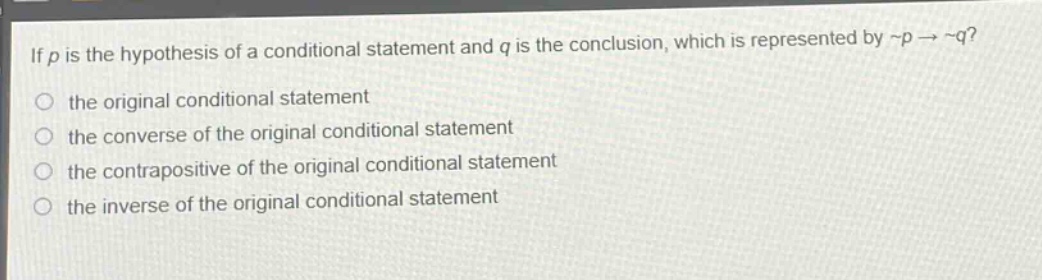
if (p) is the hypothesis of a conditional statement and (q) is the conclusion, which is represented by (\neg p\rightarrow\neg q)?\n the original conditional statement\n the converse of the original conditional statement\n the contrapositive of the original conditional statement\n the inverse of the original conditional statement
Answer
Answer:
D. the inverse of the original conditional statement
Brief Explanations:
The original conditional is (p\rightarrow q). The inverse is formed by negating both (p) and (q), resulting in (\neg p\rightarrow\neg q).