identifying the graph of an inequality\nwhich is the graph of 2x - 4y > 6?
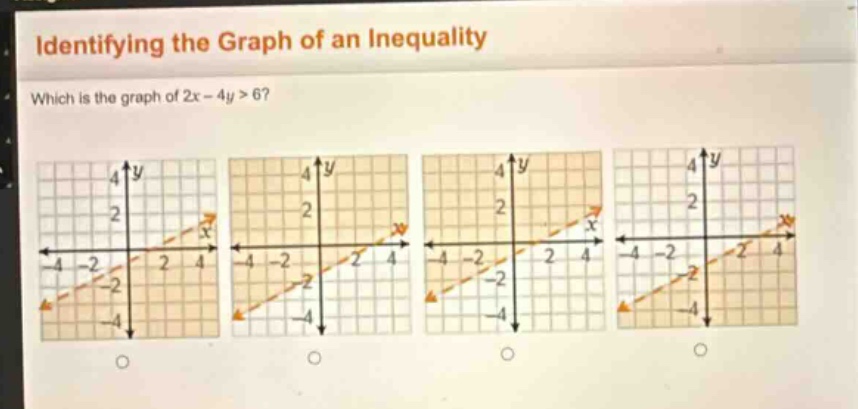
identifying the graph of an inequality\nwhich is the graph of 2x - 4y > 6?
Answer
Answer:
First, rewrite the inequality $2x - 4y>6$ in slope - intercept form $y=mx + b$.
- Start by isolating $y$:
- Subtract $2x$ from both sides of the inequality: $-4y>-2x + 6$.
- Divide each term by $-4$. Remember, when dividing or multiplying an inequality by a negative number, the direction of the inequality sign changes. So we get $y<\frac{1}{2}x-\frac{3}{2}$.
- Analyze the key features of the line $y = \frac{1}{2}x-\frac{3}{2}$:
- The slope $m=\frac{1}{2}$, which means for every increase of 1 in the $x$ - value, the $y$ - value increases by $\frac{1}{2}$.
- The $y$ - intercept $b =-\frac{3}{2}=-1.5$.
- Analyze the inequality $y<\frac{1}{2}x-\frac{3}{2}$:
- Since the inequality is $y<\frac{1}{2}x-\frac{3}{2}$, the line $y = \frac{1}{2}x-\frac{3}{2}$ will be a dashed line (because the inequality is strict, i.e., $y$ is strictly less than, not less than or equal to).
- To find which side of the line to shade, we can test a point. Let's test the point $(0,0)$.
- Substitute $x = 0$ and $y = 0$ into the original inequality $2x-4y>6$. We get $2(0)-4(0)=0$, and $0\not>6$. So, we shade the side of the line that does not contain the point $(0,0)$.
The graph of the inequality $y<\frac{1}{2}x-\frac{3}{2}$ has a dashed line with a slope of $\frac{1}{2}$ and a $y$ - intercept of $-1.5$, and the shading is below the line.
Explanation:
Step1: Rewrite in slope - intercept form
Subtract $2x$ from both sides: $-4y>-2x + 6$.
Step2: Solve for $y$
Divide by $-4$ and reverse the inequality: $y<\frac{1}{2}x-\frac{3}{2}$.
Step3: Identify slope and y - intercept
Slope $m = \frac{1}{2}$, $y$ - intercept $b=-\frac{3}{2}$.
Step4: Determine line type
Since $y<\frac{1}{2}x-\frac{3}{2}$, the line is dashed.
Step5: Find the shaded region
Test the point $(0,0)$ in the original inequality. Since $0\not>6$, shade the side not containing $(0,0)$.