identifying an inequality from its graph\nwhich inequality is represented by the graph?\n$y>-\frac{2}{3}x +…
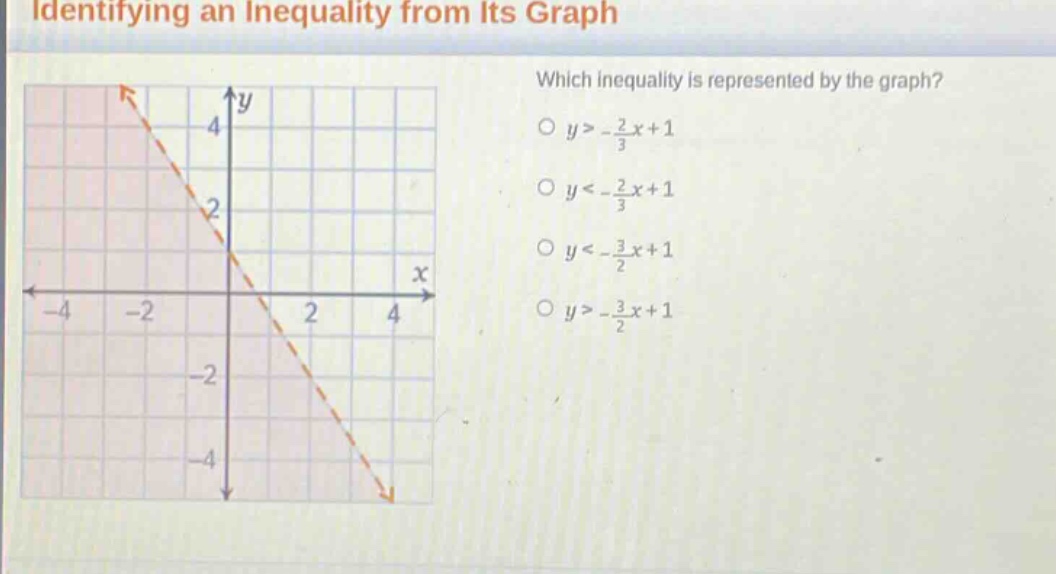
identifying an inequality from its graph\nwhich inequality is represented by the graph?\n$y>-\frac{2}{3}x + 1$\n$y<-\frac{2}{3}x + 1$\n$y<-\frac{3}{2}x + 1$\n$y>-\frac{3}{2}x + 1$
Answer
Explanation:
Step1: Find the slope - intercept form of the line
The equation of a line in slope - intercept form is $y = mx + b$, where $m$ is the slope and $b$ is the y - intercept. The y - intercept of the line in the graph is $b = 1$. To find the slope, we use two points on the line. Let's take $(0,1)$ and $(3,-1)$. The slope $m=\frac{y_2 - y_1}{x_2 - x_1}=\frac{-1 - 1}{3-0}=-\frac{2}{3}$. So the equation of the line is $y=-\frac{2}{3}x + 1$.
Step2: Determine the inequality
The line is dashed, so the inequality is either $y>-\frac{2}{3}x + 1$ or $y<-\frac{2}{3}x + 1$. We test a point in the shaded region. Let's use the origin $(0,0)$. Substitute $x = 0$ and $y = 0$ into the inequalities. For $y>-\frac{2}{3}x + 1$, we have $0>-\frac{2}{3}(0)+1$ or $0 > 1$ (false). For $y<-\frac{2}{3}x + 1$, we have $0<-\frac{2}{3}(0)+1$ or $0 < 1$ (true).
Answer:
$y<-\frac{2}{3}x + 1$