inga is solving $2x^{2}+12x - 3 = 0$. which steps could she use to solve the quadratic equation? select…
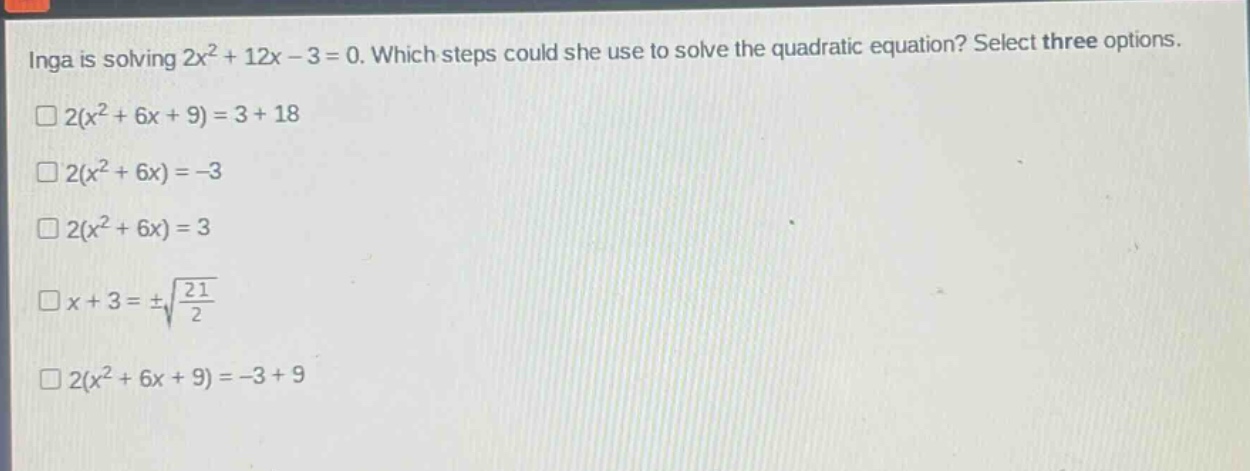
inga is solving $2x^{2}+12x - 3 = 0$. which steps could she use to solve the quadratic equation? select three options.\n$2(x^{2}+6x + 9)=3 + 18$\n$2(x^{2}+6x)=-3$\n$2(x^{2}+6x)=3$\n$x + 3=pmsqrt{\frac{21}{2}}$\n$2(x^{2}+6x + 9)=-3 + 9$
Answer
Explanation:
Step1: Isolate the terms with x
Starting with $2x^{2}+12x - 3=0$, we first move the constant - 3 to the other side: $2x^{2}+12x=3$. Then factor out the 2 from the left - hand side: $2(x^{2}+6x)=3$.
Step2: Complete the square inside the parentheses
For the quadratic expression $x^{2}+6x$, to complete the square, we take half of the coefficient of x (which is 6), square it. Half of 6 is 3, and $3^{2}=9$. We add 9 inside the parentheses on the left - hand side. To keep the equation balanced, we add $2\times9 = 18$ to the right - hand side. So we get $2(x^{2}+6x + 9)=3 + 18$.
Step3: Solve for x after completing the square
Starting from $2(x^{2}+6x + 9)=3 + 18$, we can rewrite $x^{2}+6x + 9$ as $(x + 3)^{2}$. So we have $2(x + 3)^{2}=21$, then $(x + 3)^{2}=\frac{21}{2}$, and $x+3=\pm\sqrt{\frac{21}{2}}$.
Answer:
$2(x^{2}+6x + 9)=3 + 18$, $2(x^{2}+6x)=3$, $x + 3=\pm\sqrt{\frac{21}{2}}$