if (x = 6) is the only (x)-intercept of the graph of a quadratic equation, which statement best describes…
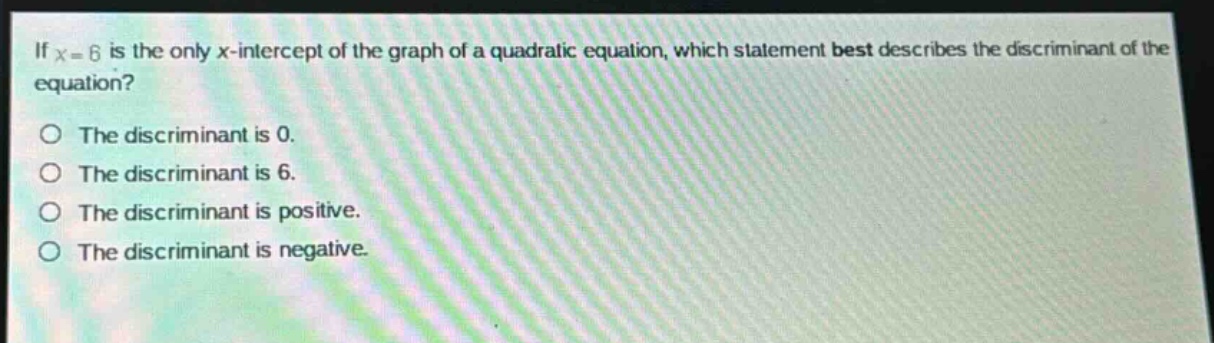
if (x = 6) is the only (x)-intercept of the graph of a quadratic equation, which statement best describes the discriminant of the equation?\nthe discriminant is 0.\nthe discriminant is 6.\nthe discriminant is positive.\nthe discriminant is negative.
Answer
Explanation:
Step1: Recall discriminant - root relationship
For a quadratic equation $ax^{2}+bx + c=0$, the discriminant $\Delta=b^{2}-4ac$. The number of $x$-intercepts is related to the number of real - roots. If there is one $x$-intercept, there is one real root.
Step2: Apply discriminant rule
When a quadratic equation $ax^{2}+bx + c = 0$ has exactly one real root, the discriminant $\Delta = 0$. Since $x = 6$ is the only $x$-intercept of the graph of a quadratic equation (meaning the quadratic equation has only one real root), the discriminant is 0.
Answer:
The discriminant is 0.