what is the inverse of the conditional statement? if a polygon has five angles, then it is a pentagon. if a…
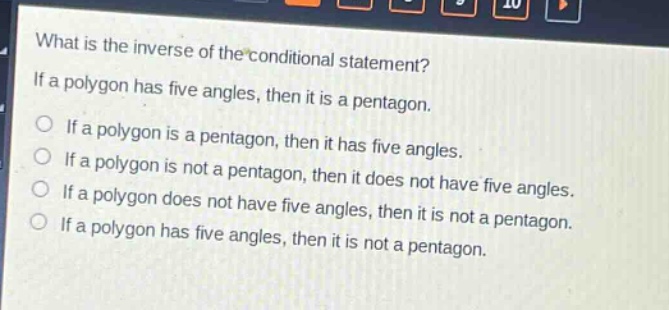
what is the inverse of the conditional statement? if a polygon has five angles, then it is a pentagon. if a polygon is a pentagon, then it has five angles. if a polygon is not a pentagon, then it does not have five angles. if a polygon does not have five angles, then it is not a pentagon. if a polygon has five angles, then it is not a pentagon.
Answer
Brief Explanations:
A conditional statement is of the form "if p then q". Its inverse is "if not p then not q". Here, p is "a polygon has five angles" and q is "it is a pentagon". So the inverse is "if a polygon does not have five angles, then it is not a pentagon".
Answer:
If a polygon does not have five angles, then it is not a pentagon.