if (f(x)) and (f^{-1}(x)) are inverse functions of each other and (f(x)=2x + 5), what is (f^{-1}(8))?\n-1\n(\…
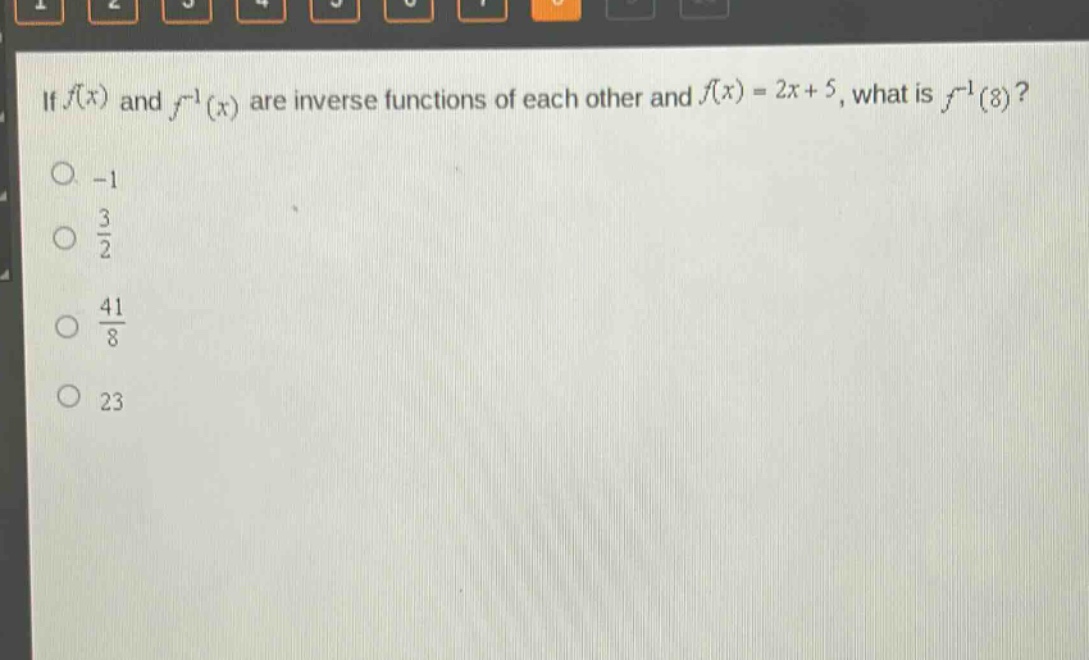
if (f(x)) and (f^{-1}(x)) are inverse functions of each other and (f(x)=2x + 5), what is (f^{-1}(8))?\n-1\n(\frac{3}{2})\n(\frac{41}{8})\n23
Answer
Explanation:
Step1: Recall inverse - function property
If (y = f(x)) and (x = f^{-1}(y)), then (f(f^{-1}(a))=a) and (f^{-1}(f(b)) = b). We want to find (f^{-1}(8)), so we set (f(x)=8). [2x + 5=8]
Step2: Solve the equation for (x)
Subtract 5 from both sides of the equation (2x+5 = 8). [2x=8 - 5] [2x=3] Then divide both sides by 2. [x=\frac{3}{2}] Since (f(x)=8) when (x = \frac{3}{2}), by the property of inverse - functions (f^{-1}(8)=\frac{3}{2}).
Answer:
(\frac{3}{2})