irina wants to build a fence around a rectangular vegetable garden so that it has a width of at least 10…
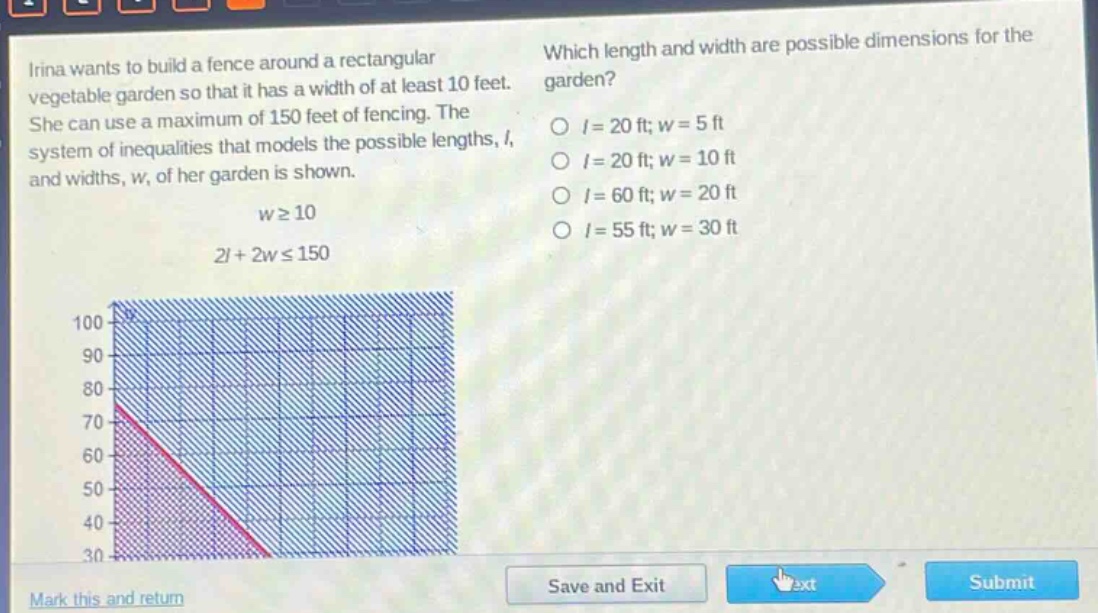
irina wants to build a fence around a rectangular vegetable garden so that it has a width of at least 10 feet. she can use a maximum of 150 feet of fencing. the system of inequalities that models the possible lengths, (l), and widths, (w), of her garden is shown.\n(wgeq10)\n(2l + 2wleq150)\nwhich length and width are possible dimensions for the garden?\n(l = 20) ft; (w = 5) ft\n(l = 20) ft; (w = 10) ft\n(l = 60) ft; (w = 20) ft\n(l = 55) ft; (w = 30) ft
Answer
Explanation:
Step1: Check the width - condition
Check if the width $w$ in each option satisfies $w\geq10$. For option A: $w = 5<10$, so option A is not valid.
Step2: Check the perimeter - condition
The perimeter formula for a rectangle is $P=2l + 2w$, and we have the inequality $2l+2w\leq150$. For option B: $l = 20$, $w = 10$, then $2l+2w=2\times20 + 2\times10=40 + 20=60\leq150$ and $w = 10\geq10$. For option C: $l = 60$, $w = 20$, then $2l+2w=2\times60+2\times20=120 + 40=160>150$, so option C is not valid. For option D: $l = 55$, $w = 30$, then $2l+2w=2\times55+2\times30=110+60 = 170>150$, so option D is not valid.
Answer:
B. $l = 20$ ft; $w = 10$ ft