the irrigation design for a new backyard is shown with four sprinkler heads and two walkways. the distance…
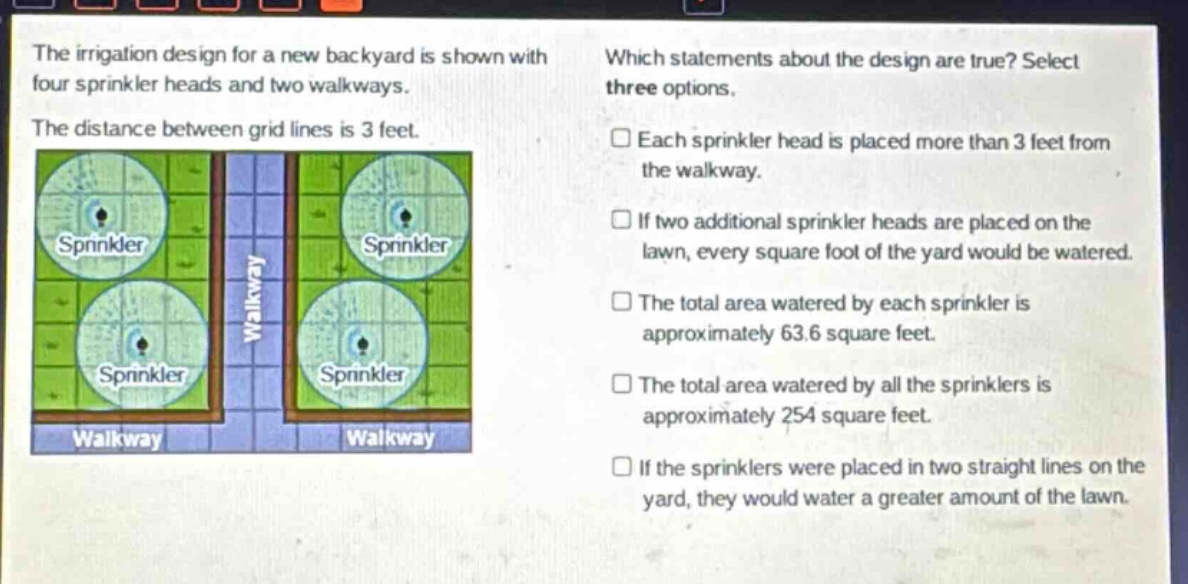
the irrigation design for a new backyard is shown with four sprinkler heads and two walkways. the distance between grid lines is 3 feet. which statements about the design are true? select three options. each sprinkler head is placed more than 3 feet from the walkway. if two additional sprinkler heads are placed on the lawn, every square foot of the yard would be watered. the total area watered by each sprinkler is approximately 63.6 square feet. the total area watered by all the sprinklers is approximately 254 square feet. if the sprinklers were placed in two straight lines on the yard, they would water a greater amount of the lawn.
Answer
Explanation:
Step1: Analyze distance from sprinkler to walkway
By observing the grid - based design, we can see that some sprinkler heads are within 3 feet of the walkway. So the statement "Each sprinkler head is placed more than 3 feet from the walkway" is false.
Step2: Consider adding two more sprinkler heads
Just adding two more sprinkler heads is not guaranteed to water every square foot of the yard without proper placement and coverage analysis. So the statement "If two additional sprinkler heads are placed on the lawn, every square foot of the yard would be watered" is false.
Step3: Calculate area watered by each sprinkler
The radius of the area watered by each sprinkler is 3 feet. The area of a circle is $A=\pi r^{2}$. Substituting $r = 3$ into the formula, we get $A=\pi\times3^{2}=9\pi\approx9\times3.14 = 28.26$ square feet. This is not approximately 63.6 square feet, so this statement is false.
Step4: Calculate area watered by all sprinklers
There are 4 sprinklers. The area watered by each sprinkler is $A=\pi r^{2}$ with $r = 3$. The total area watered by all 4 sprinklers is $4\times\pi r^{2}=4\times\pi\times3^{2}=36\pi\approx36\times3.14 = 113.04$ square feet. This is not approximately 254 square feet, so this statement is false.
Step5: Analyze sprinkler placement in straight lines
If the sprinklers were placed in two straight lines, there would be less overlap and potentially a greater area of the lawn would be watered. This statement is true.
Answer:
If the sprinklers were placed in two straight lines on the yard, they would water a greater amount of the lawn.