if isosceles triangle abc has a 130° angle at vertex b, which statement must be true?\no m∠a = 15° and m∠c =…
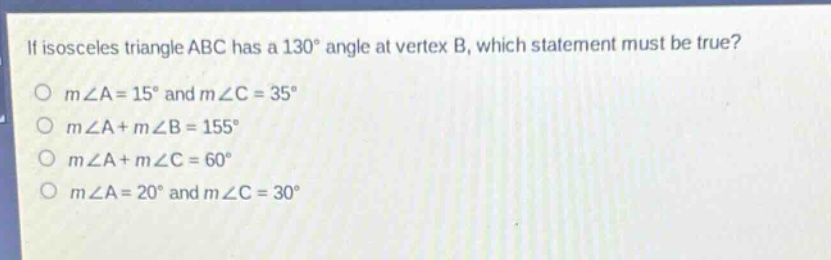
if isosceles triangle abc has a 130° angle at vertex b, which statement must be true?\no m∠a = 15° and m∠c = 35°\no m∠a + m∠b = 155°\no m∠a + m∠c = 60°\no m∠a = 20° and m∠c = 30°
Answer
Explanation:
Step1: Recall angle - sum property of a triangle
The sum of the interior angles of a triangle is (180^{\circ}), i.e., (m\angle A + m\angle B+m\angle C=180^{\circ}). Given (m\angle B = 130^{\circ}).
Step2: Find the sum of (\angle A) and (\angle C)
Substitute (m\angle B = 130^{\circ}) into the angle - sum formula: (m\angle A + m\angle C=180^{\circ}-m\angle B). So (m\angle A + m\angle C=180 - 130=50^{\circ}). Since (\triangle ABC) is isosceles and (\angle B) is the non - congruent angle, (m\angle A=m\angle C). Then (m\angle A=m\angle C = 25^{\circ}). Let's check each option:
- Option 1: (m\angle A = 15^{\circ}) and (m\angle C = 35^{\circ}), (15 + 35=50^{\circ}), but (m\angle A\neq m\angle C) for an isosceles triangle with (\angle B) non - congruent, so this is wrong.
- Option 2: (m\angle A+m\angle B): Since (m\angle B = 130^{\circ}) and (m\angle A+m\angle C = 50^{\circ}), (m\angle A+m\angle B=130^{\circ}+m\angle A). If (m\angle A + m\angle B=155^{\circ}), then (m\angle A=155 - 130 = 25^{\circ}), and (m\angle C = 25^{\circ}), (m\angle A+m\angle B=25^{\circ}+130^{\circ}=155^{\circ}), this option is correct.
- Option 3: (m\angle A + m\angle C=50^{\circ}\neq60^{\circ}), so this is wrong.
- Option 4: (m\angle A = 20^{\circ}) and (m\angle C = 30^{\circ}), (20+30 = 50^{\circ}), but (m\angle A\neq m\angle C) for an isosceles triangle with (\angle B) non - congruent, so this is wrong.
Answer:
(m\angle A + m\angle B=155^{\circ})