ivan and polina have each drawn a conclusion about multiplying negative fractions. ivan: the product of an…
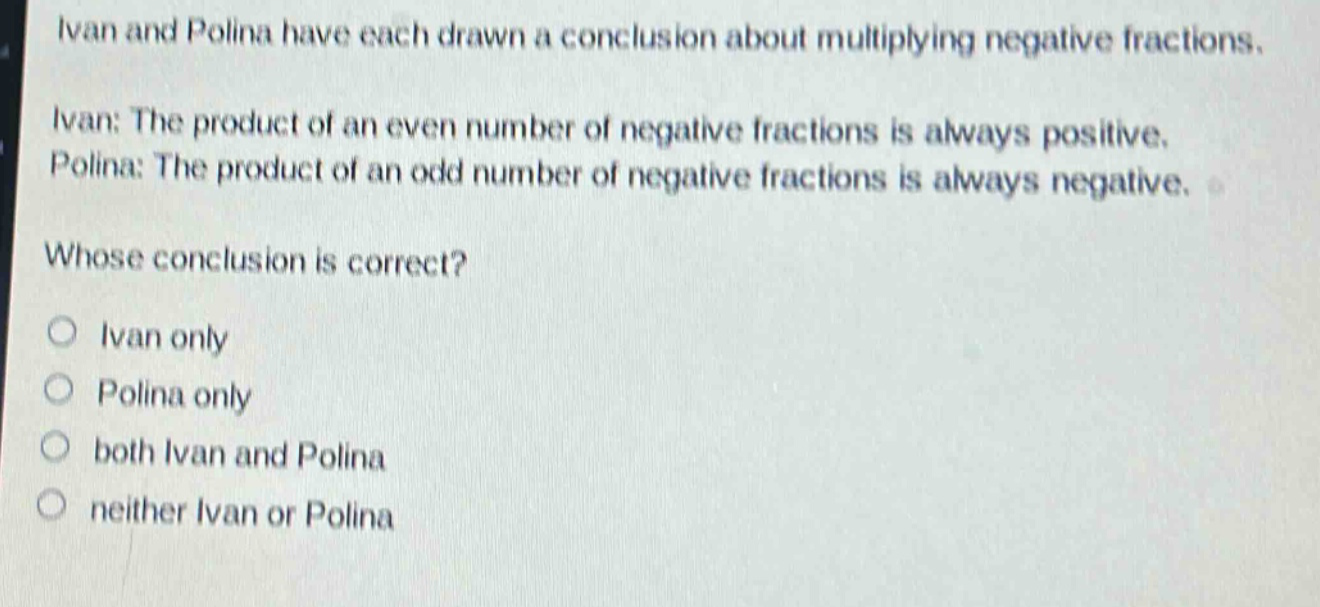
ivan and polina have each drawn a conclusion about multiplying negative fractions. ivan: the product of an even number of negative fractions is always positive. polina: the product of an odd number of negative fractions is always negative. whose conclusion is correct? ivan only polina only both ivan and polina neither ivan or polina
Answer
Explanation:
Step1: Recall multiplication rule of negative numbers
When multiplying negative numbers, if there are an even - number of negative factors, the product is positive. For example, $(-\frac{1}{2})\times(-\frac{1}{3})=\frac{1}{6}$. Ivan's statement about negative fractions follows this rule.
Step2: Recall multiplication rule of negative numbers
When multiplying negative numbers, if there are an odd - number of negative factors, the product is negative. For example, $(-\frac{1}{2})\times(-\frac{1}{3})\times(-\frac{1}{4})=-\frac{1}{24}$. Polina's statement about negative fractions follows this rule.
Answer:
C. both Ivan and Polina