joey is buying plants for his garden. he wants to have at least twice as many flowering plants as non…
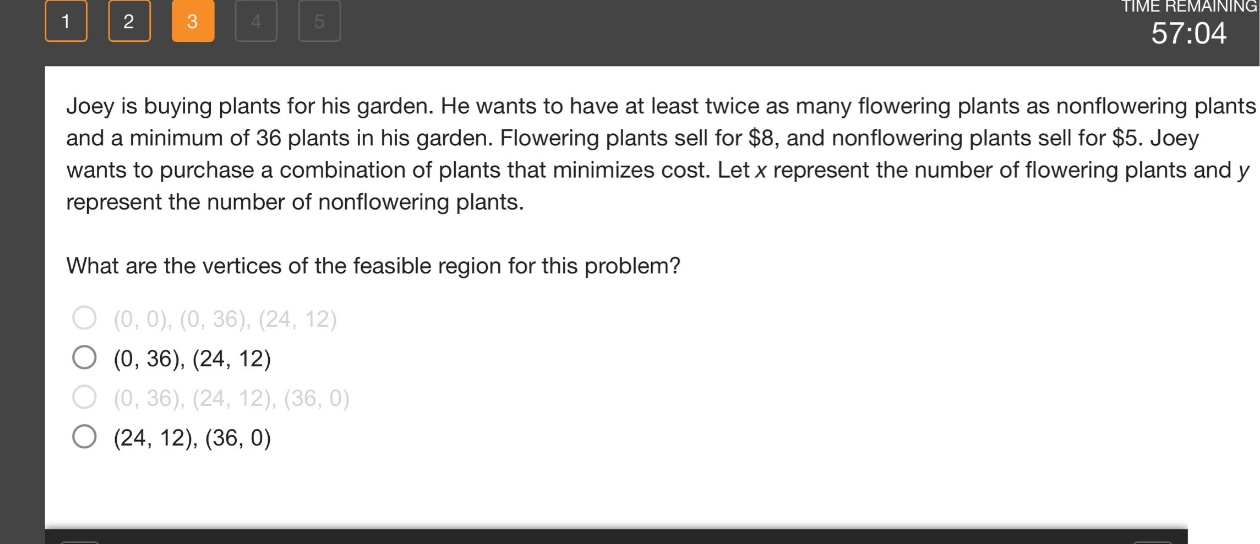
joey is buying plants for his garden. he wants to have at least twice as many flowering plants as non - flowering plants and a minimum of 36 plants in his garden. flowering plants sell for $8, and non - flowering plants sell for $5. joey wants to purchase a combination of plants that minimizes cost. let x represent the number of flowering plants and y represent the number of non - flowering plants. what are the vertices of the feasible region for this problem? (0, 0), (0, 36), (24, 12) (0, 36), (24, 12) (0, 36), (24, 12), (36, 0) (24, 12), (36, 0)
Answer
Explanation:
Step1: Set up inequalities
We have two - conditions:
- $x\geq2y$ (at least twice as many flowering plants as non - flowering plants).
- $x + y\geq36$ (a minimum of 36 plants), and $x\geq0,y\geq0$ (non - negative number of plants).
Step2: Find intersection points
Intersection of $x + y=36$ and $x = 2y$: Substitute $x = 2y$ into $x + y=36$, we get $2y+y=36$, so $3y=36$ and $y = 12$. Then $x=2y = 24$. The intersection point is $(24,12)$. Intersection of $x + y=36$ and $y = 0$: Substitute $y = 0$ into $x + y=36$, we get $x=36$. The intersection point is $(36,0)$. Intersection of $x + y=36$ and $x = 0$: Substitute $x = 0$ into $x + y=36$, we get $y=36$. But from $x\geq2y$, when $x = 0$, $0\geq2y$ and $y = 0$. We ignore the point $(0,36)$ because it does not satisfy $x\geq2y$. Also, the point $(0,0)$ does not satisfy $x + y\geq36$.
Answer:
$(24, 12),(36, 0)$