kate begins solving the equation $\frac{2}{3}(6x - 3)=\frac{1}{2}(6x - 4)$. her work is correct and is shown…
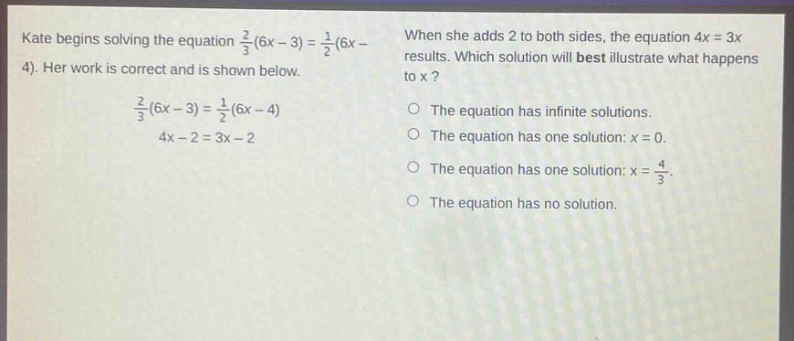
kate begins solving the equation $\frac{2}{3}(6x - 3)=\frac{1}{2}(6x - 4)$. her work is correct and is shown below. $\frac{2}{3}(6x - 3)=\frac{1}{2}(6x - 4)$ $4x - 2 = 3x - 2$ when she adds 2 to both sides, the equation $4x = 3x$ results. which solution will best illustrate what happens to x? the equation has infinite solutions. the equation has one solution: $x = 0$. the equation has one solution: $x=\frac{4}{3}$. the equation has no solution.
Answer
Explanation:
Step1: Start with the equation after adding 2 to both sides
We have $4x = 3x$.
Step2: Subtract $3x$ from both sides
$4x-3x=3x - 3x$.
Step3: Simplify the equation
$x = 0$.
Answer:
The equation has one solution: $x = 0$.