keshawn is asked to compare and contrast the domain and range for the two functions.\n\n$f(x)=5x$\n$g(x)=5^{x…
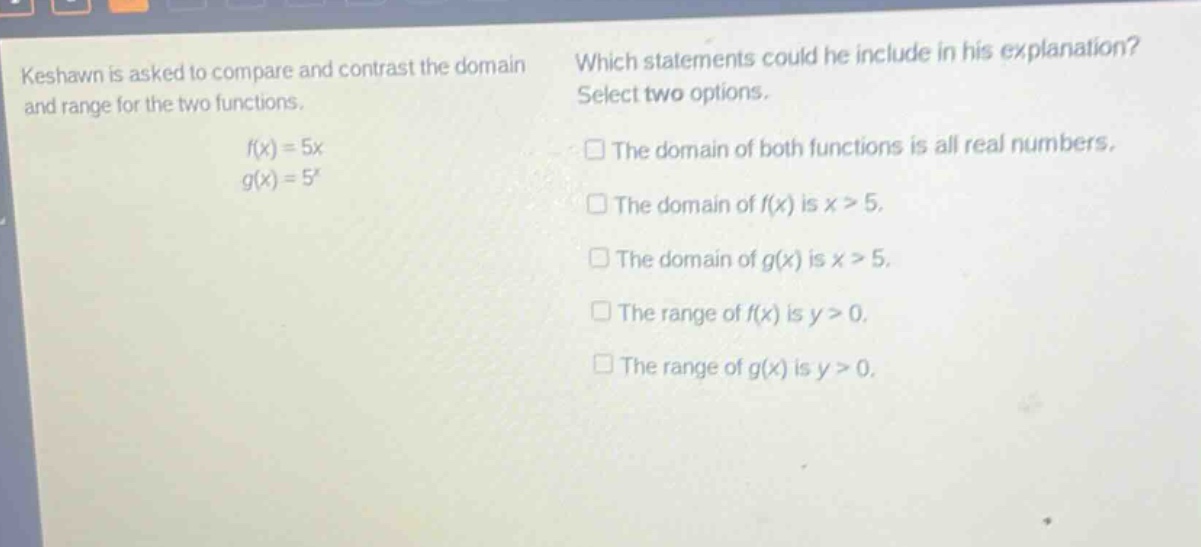
keshawn is asked to compare and contrast the domain and range for the two functions.\n\n$f(x)=5x$\n$g(x)=5^{x}$\n\nwhich statements could he include in his explanation? select two options.\n\n□ the domain of both functions is all real numbers.\n□ the domain of $f(x)$ is $x > 5$.\n□ the domain of $g(x)$ is $x > 5$.\n□ the range of $f(x)$ is $y > 0$.\n□ the range of $g(x)$ is $y > 0$.
Answer
Explanation:
Step1: Analyze domain of (f(x) = 5x)
The linear - function (f(x)=5x) is defined for all real - valued inputs (x). So, its domain is all real numbers.
Step2: Analyze domain of (g(x)=5^{x})
The exponential function (g(x) = 5^{x}) is also defined for all real - valued inputs (x). So, its domain is all real numbers.
Step3: Analyze range of (f(x)=5x)
The linear function (f(x)=5x) can output any real number. Its range is all real numbers.
Step4: Analyze range of (g(x)=5^{x})
For the exponential function (g(x)=5^{x}), since (5^{x}\gt0) for all real (x), the range is (y > 0).
Answer:
The domain of both functions is all real numbers, The range of (g(x)) is (y>0)