keshawn is asked to compare and contrast the domain and range for the two functions. f(x)=5x g(x)=5^x which…
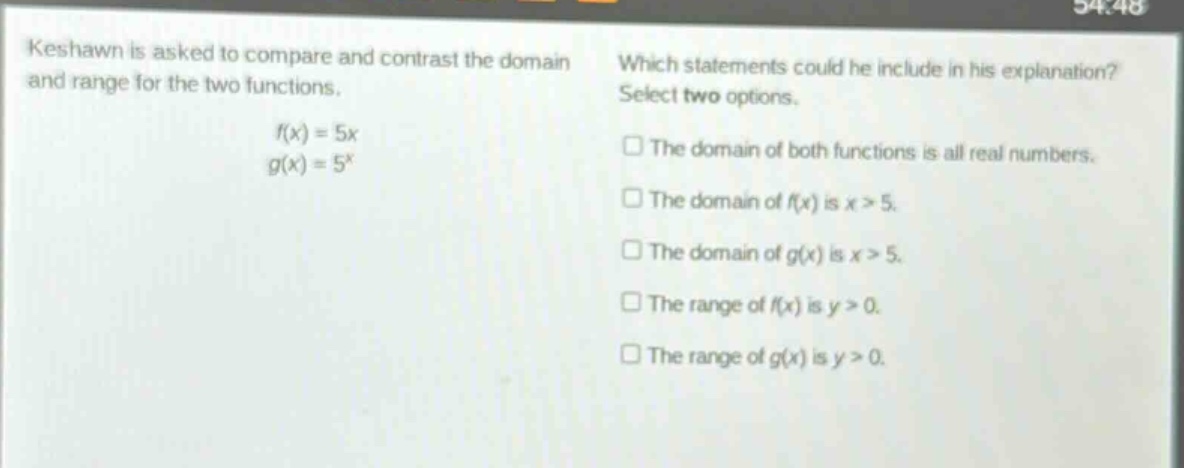
keshawn is asked to compare and contrast the domain and range for the two functions. f(x)=5x g(x)=5^x which statements could he include in his explanation? select two options. the domain of both functions is all real numbers. the domain of f(x) is x > 5. the domain of g(x) is x > 5. the range of f(x) is y > 0. the range of g(x) is y > 0.
Answer
Explanation:
Step1: Recall domain - linear function
For the linear function $f(x)=5x$, we can substitute any real - number for $x$. So the domain of $f(x)$ is all real numbers, $(-\infty,\infty)$.
Step2: Recall range - linear function
As we can get any real - valued output by choosing appropriate real - valued inputs for $f(x)=5x$, the range of $f(x)$ is all real numbers, $(-\infty,\infty)$.
Step3: Recall domain - exponential function
For the exponential function $g(x) = 5^{x}$, we can substitute any real number for $x$. So the domain of $g(x)$ is all real numbers, $(-\infty,\infty)$.
Step4: Recall range - exponential function
Since $5^{x}>0$ for all real values of $x$ (because any positive number $a$ raised to a real power $x$, $a^{x}>0$ when $a > 0$), the range of $g(x)$ is $(0,\infty)$.
Answer:
The domain of both functions is all real numbers. The range of $g(x)$ is $y>0$.